
Construction site register template Make a printable A4 sign-in sheet with your logo, then download it as PDF, Excel or Word.
Choose a design
Five site register layouts, from a daily sign-in sheet to an induction register
A register is how most sites show who was inducted, who is on site and who to count after an evacuation. The daily sheet does the count, the visitor book covers the gate, and the induction register takes each person once.
Daily sign-in sheet
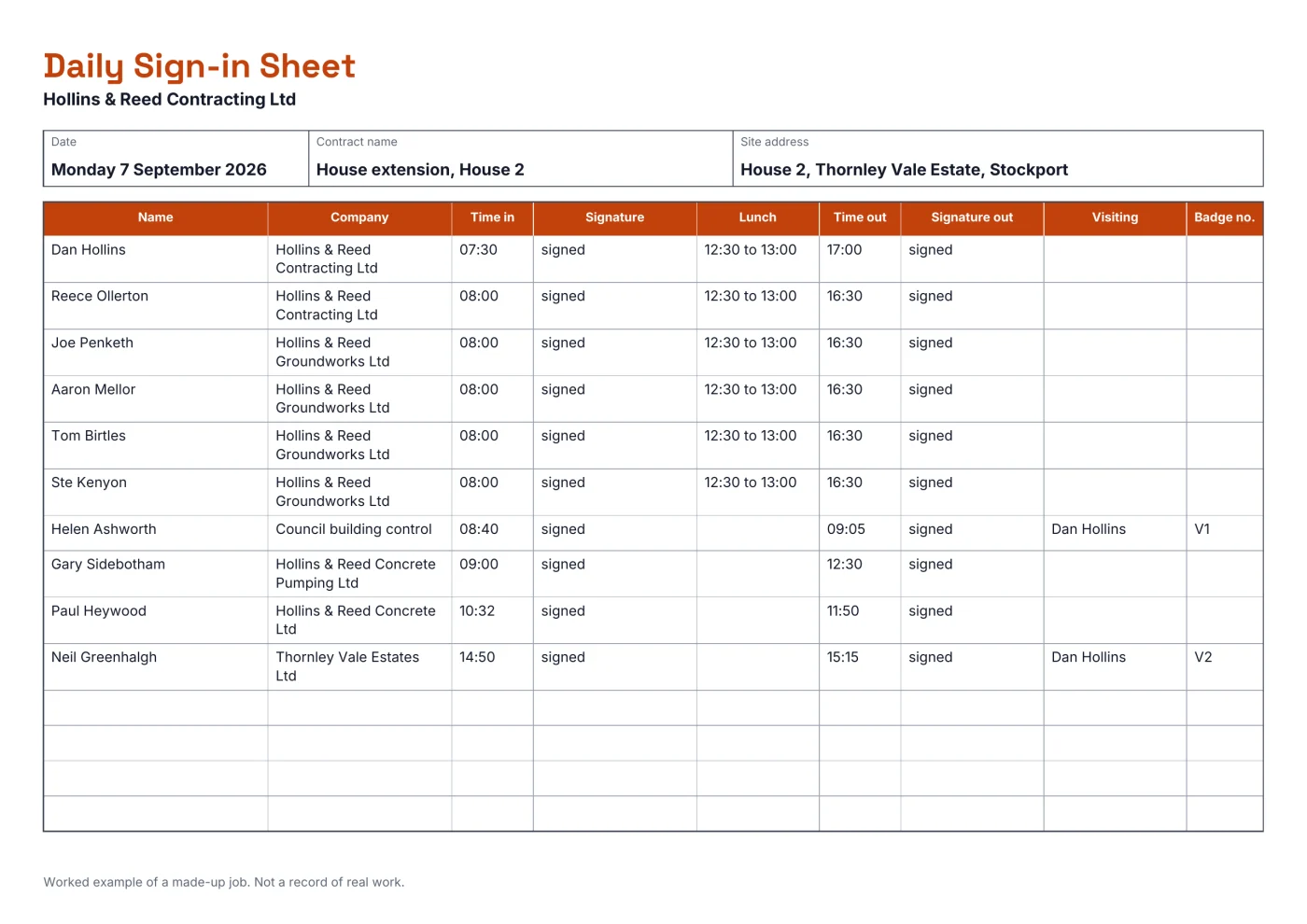
In and out with a signature each way. Take it to the assembly point.
Weekly site register
Attendance for the week: time on and off for each day, on one sheet.
Visitor sign-in book
Who they came to see, a badge number and a tick for the induction.
Induction register
Each person once, with the date and their signature.
Toolbox talk register
Who heard the talk, with a signature each.
What a site sign-in sheet records
Name and company
Who is on site, and who to call about them.
Time in and signature
Who arrived and when, in their own hand.
Time out and signature out
Who is still inside. Checking names off against the sheet at the assembly point is one of the ways HSE gives to confirm everyone is out.
Visiting
Who a visitor came to see, so you can tell the fire service where they are likely to be.
Badge no.
Which visitor passes are still out.
The law asks for outcomes, not a sheet. The principal contractor must induct every worker and keep unauthorised people off the site (CDM 2015, regulation 13(4)), plan the evacuation (CDM 2015, regulation 30) and make sure people can be accounted for at the assembly point (HSG168, paragraph 250). A register is the usual way to show it.
In a fire, take the sheet to the assembly point and count against it (HSG168, paragraph 308). That only works if everyone signs out. The weekly register has time on and off for each day; the daily sheet adds a signature each way and a fresh page each morning.
The daily sign-in sheet exampleVisitors and contractors
- An escorted visitor needs only the main hazards and the controls (L153, paragraph 134), and must be told what to do in a fire (HSG168, paragraph 323).
- On a larger site, each contractor should know which parts of the site they may enter, and when (L153, paragraph 174).
- On a small job, that check can be a phone call or an early meeting with the principal contractor, and a contractor working alone does what is proportionate (L153, paragraphs 174 and 175).
- A site pass can carry the fire instructions (HSG168, paragraph 323).
Use the visitor book for visitors, and the daily sheet for everyone else.
Site register questions
Is a site sign-in sheet a legal requirement?
No law requires the sheet itself. The duties it shows are law: induct everyone, keep unauthorised people out (CDM 2015, regulation 13(4)) and be able to account for everyone after an evacuation (HSG168, paragraph 250). Most sites use a register to show they do.
Do visitors have to sign in?
A visitor needs an induction that suits the visit (L153, paragraph 134) and must know what to do in a fire (HSG168, paragraph 323). Signing them in and out is how you count them.
How long should I keep sign-in sheets?
No law sets a period. Decide how long you need them, write that down, and destroy them after (ICO, storage limitation).
Do I need a CSCS card number on the register?
Only if your principal contractor or client requires cards. Holding one is not a legal requirement (CSCS). Check a card with CSCS Smart Check; you need not copy the number (ICO, data minimisation).
Who runs the count after an evacuation?
The person responsible for fire safety, usually the main or principal contractor (HSE, general fire safety on construction sites). They name enough competent people to carry out the evacuation (Fire Safety Order 2005, article 15).
Is it free?
Yes. There is no account and no email to give. The files are made in your browser.