
RAMS template
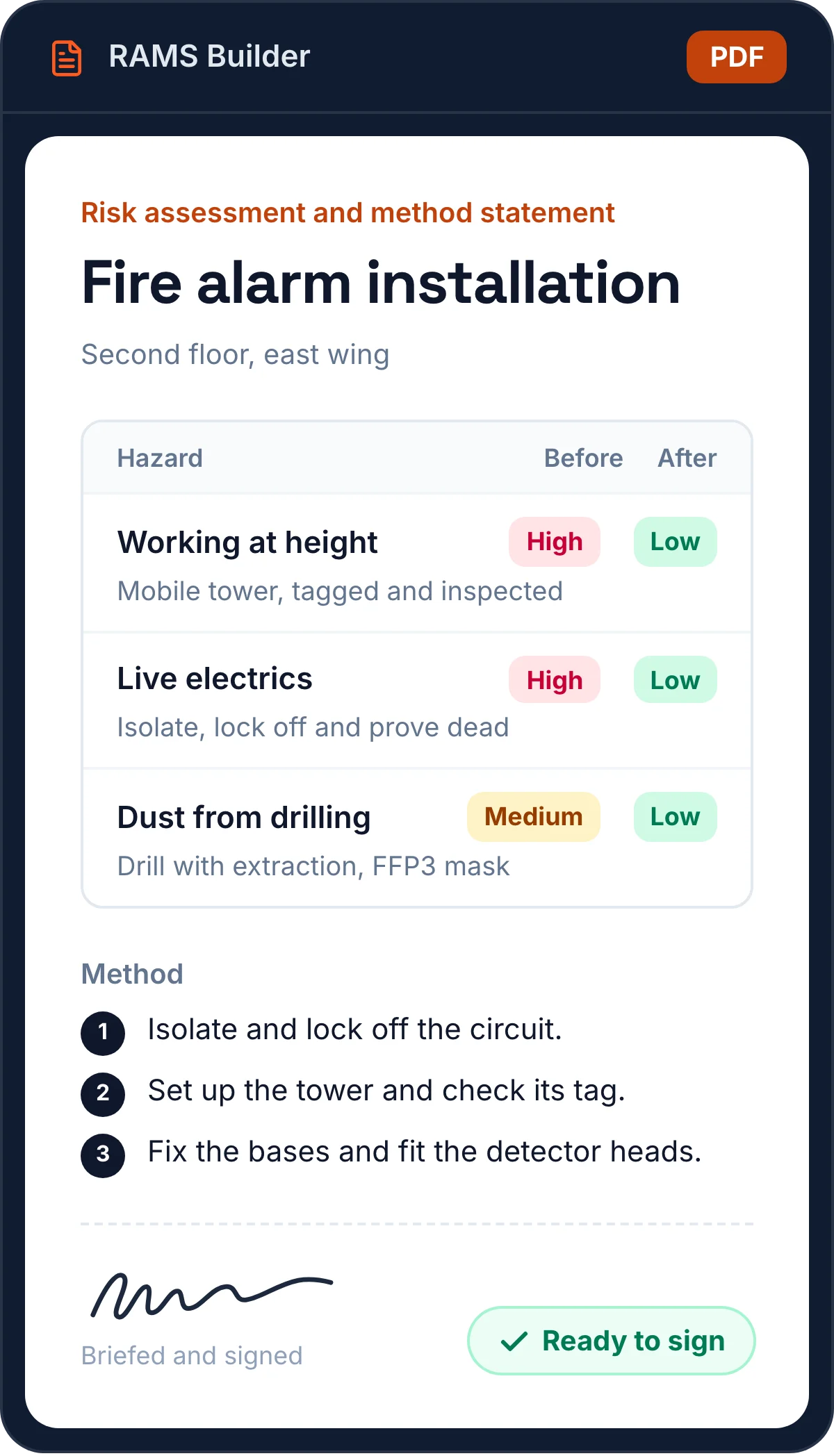
A blank RAMS for any job: type of work, job details, method statement, risk assessment and briefing record.
Risk assessment and method statement
RAMS
Type of workleft blank to fill in
- Company
- left blank to fill in
- Site and work area
- left blank to fill in
- Planned dates
- left blank to fill in
- In charge on site
- left blank to fill in
- Team
- left blank to fill in
Method statement
- 1
- 2
- 3
- 4
- 5
- 6
Risk assessment
| Hazard | Who might be harmed and how | Controls in place | Further action |
|---|---|---|---|
RAMS example
A RAMS filled in for one electrical job.
Risk assessment and method statement
Electrical, Unit 3, Canal Side Business Park, Stockport: workshop
- Company
- Hollins & Reed Electrical Ltd
- Site and work area
- Unit 3, Canal Side Business Park, Stockport: workshop
- Planned dates
- 12 October 2026 (one day)
- In charge on site
- Dan Hollins
- Team
- Two electricians: Dan Hollins leads and holds the isolation lock; Priya Shah works with him.
Method statement
- 1Set up the work areaConfirm the work area and scope before starting. Keep other people outside the active work area. Keep entrances and escape routes clear.
- 2Keep people clear of the workAgree how people get past or around the work while it is going on. Put barriers or signs where a route crosses the work. Do not leave open work unattended.
- 3Check permits before workAsk whoever runs the site or building whether this job needs a permit to work, permit to isolate or another site permit. Do not start until the required permit is issued and its limits are understood.
- 4Confirm the change before opening itName the circuit and item being changed. Check the design or product instructions before touching retained wiring.
- 5Isolate and prove deadFind every supply that feeds the work, switch it off and lock it off before you open or touch anything. Prove your tester on a known live supply, test every conductor at the work point, then prove the tester again.
- 6Keep it locked off while it is openKeep the supply locked off while the item is open, so nobody can put it back on. Test at the work point again before you touch it.
- 7Identify the retained conductorsMark each conductor before removal. Stop if the cable, joint or protective path is not what the information says.
- 8Fit the specified replacementRemove the old item without damaging retained wiring. Fit the compatible item and remake each termination to its instructions.
- 9Inspect the change before it goes liveInspect the completed work and arrange the testing it needs before it goes back on. Record anything left disconnected or out of service.
- 10Control live testingDo dead checks first; test live only when it is necessary and a competent person has planned it. Use suitable leads, probes, barriers and a controlled area, then re-isolate before changing connections.
- 11Finish the tests and functional checksComplete the required tests and functional checks. Check covers, guards, labels, fire stopping and connections. Give actual results, defects and restrictions to the customer or site contact. Do not certify unchecked work.
- 12Clear and hand back the areaRemove tools, waste and unused materials. Check the area is clean and ready to use. Tell the customer or whoever runs the site when the work is complete.
Risk assessment
People entering the work area or tripping over materials
Workers, occupants and visitors
Mark or barrier the active work area. Store tools and materials away from access routes.
People using the building or passing by walking into the work or over what it leaves
Occupants, visitors, members of the public and workers
Keep the barriers and signs up while the work is active. Give people a clear way round where their normal route is blocked.
Work starts without the site controls for isolation, access or a dangerous area
The electrician and other workers on site
Keep the permit with the work record and follow its boundaries. Stop when the permit is missing, expired or does not cover the actual work.
The wrong circuit, item or compatibility assumption causes shock, fire or loss of protection
Electricians and building users
Stay inside the agreed scope. Stop for an unexpected arrangement or missing information.
A live conductor or backfeed causes electric shock, burns or an unexpected start
The electrician and anyone near the work
Lock off the supply and put your own tag on it. Stop if you cannot find every supply or cannot get a dead reading.
A live conductor causes electric shock or burns during removal
The electrician
Use the safe isolation steps for this installation. Leave your lock and warning tag on while the work goes on.
A wrong reconnection or damaged protective path causes overheating or electric shock
The electrician and users
Keep conductor identity with the circuit. Do not interrupt an earth or bonding path without the agreed method.
A loose, wrong or damaged termination overheats or leaves the installation unsafe
The electrician and building users
Use the specified component and termination method. Keep covers, cable restraint and protective connections complete.
Unverified work or an incomplete circuit is returned to use
The electrician and everyone using the installation
Do not energise work that has failed verification. Tell the customer or site contact about defects and restrictions.
Exposed live parts or unexpected operation causes shock, burns, falls or fire
The electrician and people near the test
Keep people outside the test boundary and use the right test equipment. Stop if the live test cannot be controlled safely.
Incomplete or unverified work is returned to use and leaves people or property unprotected
The electrician, the customer or site contact and people using the building
Record what was tested, what remains out of service and who accepted the hand-back. Do not energise or certify a failed or incomplete installation.
Debris, tools or unfinished work left in the area
Workers, occupants and visitors
Remove waste by the agreed route. Record and protect any unfinished work.
RAMS for your trade or task
Each has its own questions, suggested steps and hazards, template and example.
Access, height and survey
Groundworks and drainage
Concrete, masonry and structure
Roofing
Cladding, glazing and weatherproofing
Carpentry, joinery and fit-out
Floors, walls and finishes
Electrical, alarms and controls
Plumbing, heating and ventilation
Hot work and metalwork
Breaking out, strip-out and demolition
Site set-up, lifting and logistics
External works and landscaping
Cleaning and building care
Pest and bird control
Higher-risk work
What one answer adds to your RAMS
Every job is asked this, whatever the trade. Each answer adds its own step and hazards.
Start with your trade
How the RAMS builder works
Choosing the work
Search for the job or pick your trade, then answer questions about how it will be done.
Writing the document
Keep the suggestions that apply and edit them. Missing site facts, products, equipment, competence and approvals are listed as still needed.
Downloading the PDF
The method statement and risk assessment come out as one A4 PDF.
What the law asks for
What a RAMS is
A risk assessment and method statement. The risk assessment records what could cause harm on the job, who could be harmed and how, and the controls that keep the risk down. The method statement sets out how the work will be done, step by step, in the order it happens.
A client or main contractor will usually ask for one before you start. RAMS is a site term, not a legal one: the law asks for the risk assessment and for the work to be planned, and a method statement is the usual way to show that plan for one job.
What the law asks for
- Employers, and self-employed people doing construction work, must make a suitable and sufficient assessment of the risks to their own people and to anyone else affected by the work (Management of Health and Safety at Work Regulations 1999, regulation 3).
- An employer with five or more employees must record the significant findings and any group of employees it finds especially at risk. The assessment must be reviewed if there is reason to think it is no longer valid, or the work has changed significantly.
- Every contractor must plan, manage and monitor its work so that, so far as is reasonably practicable, it is done without risks to health and safety, and must give its workers the information and instructions they need, including the hazards the risk assessment found (Construction (Design and Management) Regulations 2015, regulation 15).
HSE guidance: the steps to manage risk and what contractors must do under CDM. This is the law in Great Britain; Northern Ireland has its own equivalent regulations.
What the builder does
You choose the work and answer questions about how the job will be done, such as what you will stand on and what else is going on nearby. Your answers decide which steps, hazards and controls it suggests.
Many suggestions link to the HSE guidance they draw on. Your work is kept in this browser and, signed in, on your account with its photos; the PDF is made on your device. A briefing you send to phones goes through your account.
Separate documents
A COSHH assessment, lifting plan, permit to work, asbestos survey and the principal contractor’s construction phase plan are separate from the RAMS.
Reviewing a RAMS before work starts
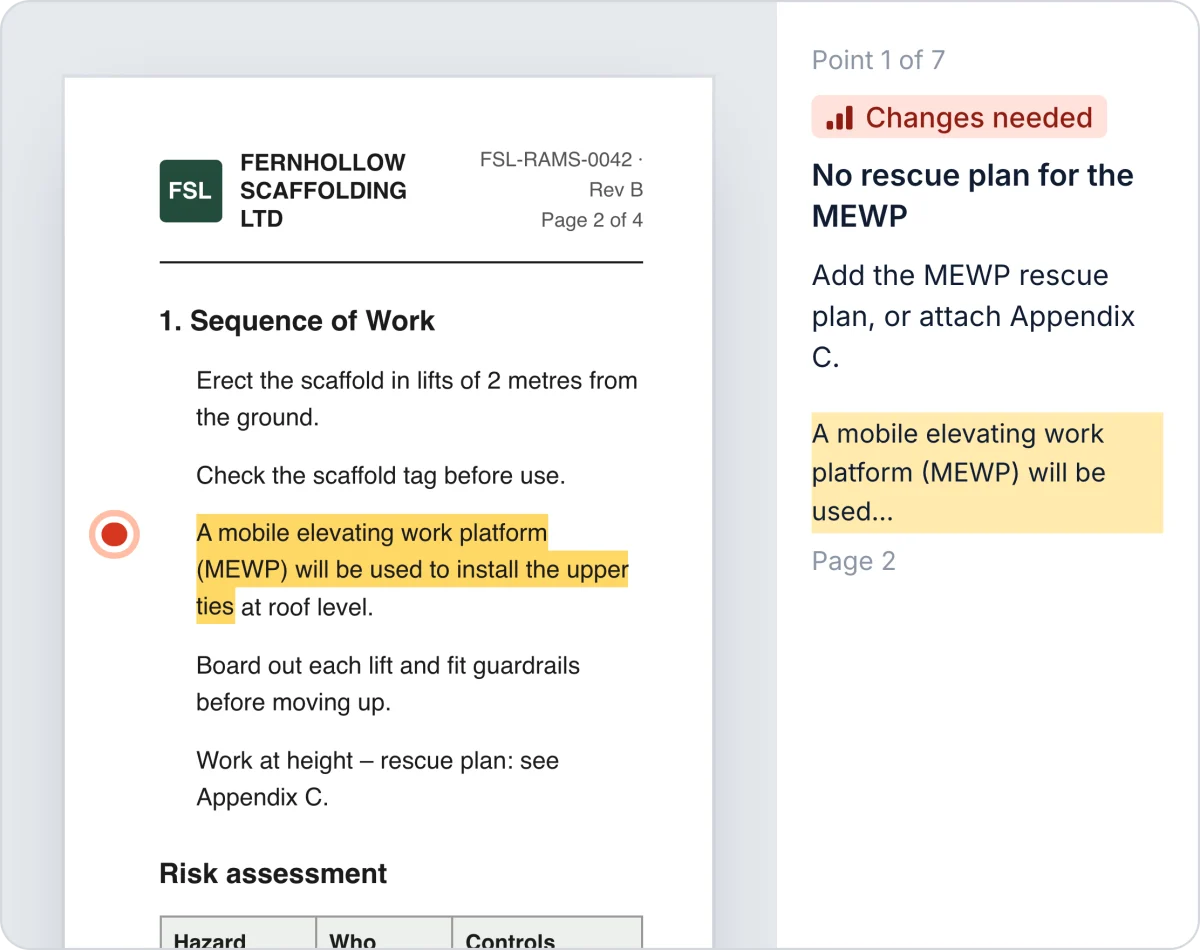
RAMS review reads a RAMS PDF, yours before you send it or one a subcontractor sends you, and lists the points to raise, each marked on the page it comes from. Quick reviews are free.