
Pest work RAMS Builder
Pest control risk assessment and method statement
Checking this browser for your work…
RAMS review
Check a RAMS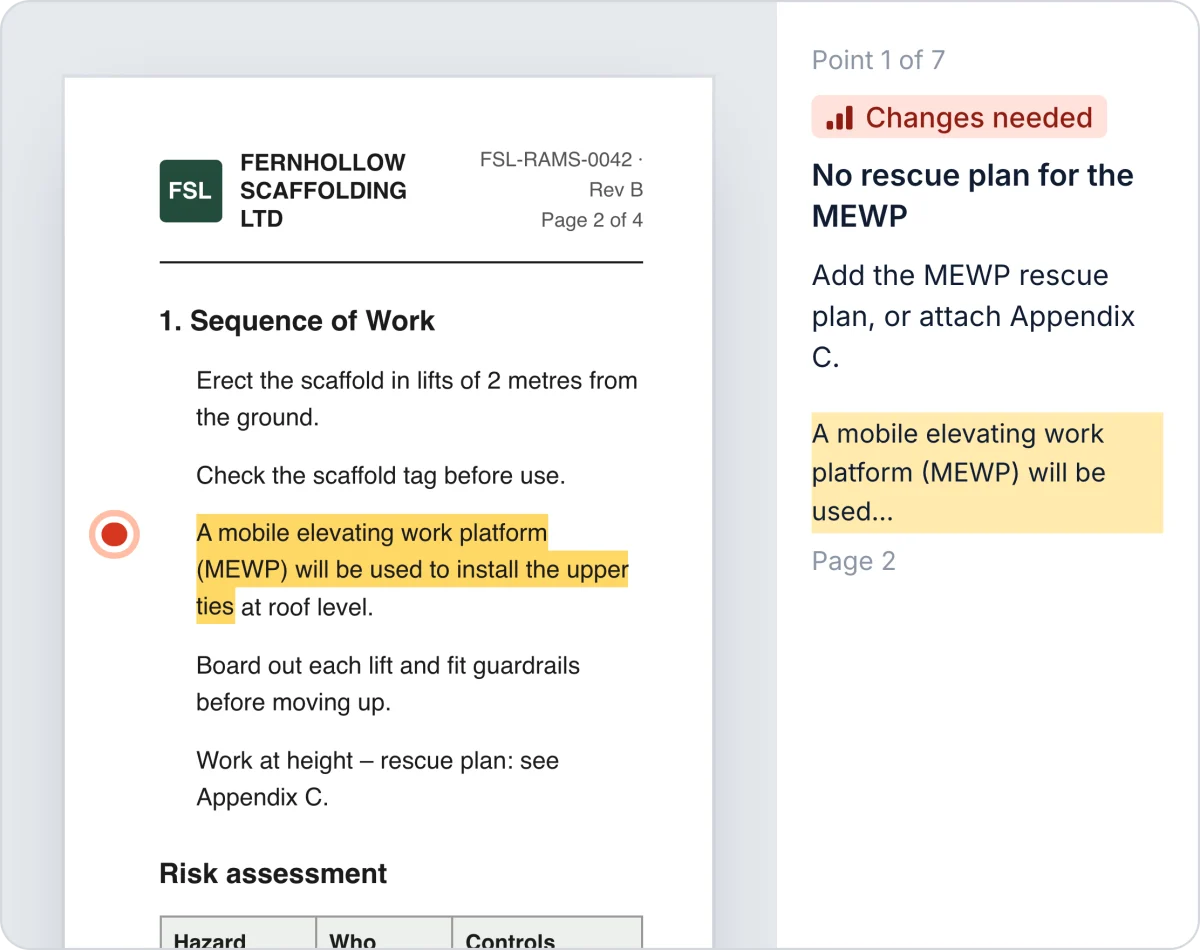
Pest work RAMS template
A blank pest work RAMS to fill in: job details, method statement, risk assessment and briefing record.
Risk assessment and method statement
Pest work RAMS
- Company
- left blank to fill in
- Site and work area
- left blank to fill in
- Planned dates
- left blank to fill in
- In charge on site
- left blank to fill in
- Team
- left blank to fill in
Method statement
- 1
- 2
- 3
- 4
- 5
- 6
Risk assessment
| Hazard | Who might be harmed and how | Controls in place | Further action |
|---|---|---|---|
Pest work RAMS example
The same RAMS, filled in for one job.
Risk assessment and method statement
Pest work, Unit 3, Canal Side Business Park, Stockport
Risk assessment
People entering the work area or tripping over materials
Workers, occupants and visitors
Mark or barrier the active work area. Store tools and materials away from access routes.
The wrong pest or area is treated
The operator, occupants and the environment
Match the treatment to the recorded survey. Stop when the pest or target area is not clear.
A chemical is used when a lower-risk method could control the pest
The operator, occupants, pets and wildlife
Record why this job's route is suitable. Do not use a product just because it is available.
Someone or something enters the treatment area or is exposed during the work
Occupants, visitors, pets, wildlife and workers
Check the area before treatment starts. Stop if the boundary cannot be controlled.
A person, pet or animal reaches treatment material or waste
Occupants, visitors, pets, wildlife and workers
Keep materials in their original container and secured from unauthorised access. Follow the label and local disposal arrangements.
An unapproved method or product creates avoidable exposure or fails to control the pest
The operator, occupants and the environment
Follow the agreed method and current product instructions. Stop when the method or product is not suitable.
Someone enters the treatment area before it is safe
Occupants, visitors, pets and workers
Keep the area controlled until the label or method allows handback. Record the warning and handback condition.
The treatment cannot be checked and later users miss its warnings
The customer, operator and future workers
Record what was actually done. Include any proofing, hygiene or follow-up recommendation.
Debris, tools or unfinished work left in the area
Workers, occupants and visitors
Remove waste by the agreed route. Record and protect any unfinished work.
Pest work, Unit 3, Canal Side Business Park, Stockport
- Company
- Hollins & Reed Contracting Ltd
- Site and work area
- Unit 3, Canal Side Business Park, Stockport
- Planned dates
- 12 to 14 October 2026
- In charge on site
- Dan Hollins
- Team
- Two operatives: Dan Hollins leads and checks the area each morning; Priya Shah works with him.
Method statement
- 1Set up the work areaConfirm the work area and scope before starting. Keep other people outside the active work area. Keep entrances and escape routes clear.
- 2Confirm the pest and target areaUse the survey findings to confirm the pest and the area to be treated. Do not treat a wider area than the evidence and agreed method cover.
- 3Choose the lowest-risk routeConsider whether proofing, hygiene, trapping or another non-chemical method can control the problem. Use a chemical only when the agreed method needs it.
- 4Set up the treatment areaRemove or protect food and keep people, pets and wildlife away from the work. Mark the treatment area and keep the agreed boundary in place.
- 5Keep treatment materials secureKeep chemicals, bait and equipment under control while they are on site. Remove waste and unused material through the route the product instructions require.
- 6Use only the agreed methodCarry out the agreed non-chemical control or use only the labelled product. Do not add an unapproved chemical, mix products or change the method on site.
- 7Check the area before handbackCheck that the treatment is complete, the warning is understood and the area is safe to use again. Leave the agreed warning and handback condition with the customer.
- 8Write the treatment reportRecord the pest, method, product details, warnings, follow-up and recommendations. Leave the customer a copy of what was done and what they must do next.
- 9Clear and hand back the areaRemove tools, waste and unused materials. Check the area is clean and ready to use. Tell the customer or whoever runs the site when the work is complete.
What a pest work RAMS covers
Surveying to identify the pest and where it is active, then treating it. Not covered: bird and rodent proofing.
- Pest survey
- Targeted pest treatment
Suggested steps and hazards for pest work
Suggested for targeted pest treatment before any questions are answered.
Confirm the pest and target area
- Use the survey findings to confirm the pest and the area to be treated.
- Do not treat a wider area than the evidence and agreed method cover.
Hazard
The wrong pest or area is treated.
Who might be harmed and how
The operator, occupants and the environment
Controls in place
- Match the treatment to the recorded survey.
- Stop when the pest or target area is not clear.
A targeted treatment must match the identified pest and the actual problem area.
Code of Best Practice for Surveys Choose the lowest-risk route
- Consider whether proofing, hygiene, trapping or another non-chemical method can control the problem.
- Use a chemical only when the agreed method needs it.
Hazard
A chemical is used when a lower-risk method could control the pest.
Who might be harmed and how
The operator, occupants, pets and wildlife
Controls in place
- Record why this job's route is suitable.
- Do not use a product just because it is available.
Considering non-chemical control can avoid unnecessary biocide exposure.
Using biocides: Overview Set up the treatment area
- Remove or protect food and keep people, pets and wildlife away from the work.
- Mark the treatment area and keep the agreed boundary in place.
Hazard
Someone or something enters the treatment area or is exposed during the work.
Who might be harmed and how
Occupants, visitors, pets, wildlife and workers
Controls in place
- Check the area before treatment starts.
- Stop if the boundary cannot be controlled.
A controlled treatment area prevents avoidable exposure while the work is under way.
Using biocides: Overview
What the builder asks about pest work
Your answers decide which steps, hazards and controls it suggests.
The job
- Which pest or sign are you dealing with?
- How far do the signs extend?
Where
- Who or what could be exposed?
- Could you inspect all the relevant areas?
- Who could enter the treatment area?
How it’s done
- What will you stand on to reach the work?
- Which treatment route is agreed?
What your pest work RAMS includes
Method statement
The work in order, step by step.
Risk assessment
Each hazard, who could be harmed, the controls in place and any further action.
The method statement and risk assessment in one A4 PDF. Your logo on Pro and Team.
What the law asks for
What a RAMS is
A risk assessment and method statement. The risk assessment records what could cause harm on the job, who could be harmed and how, and the controls that keep the risk down. The method statement sets out how the work will be done, step by step, in the order it happens.
A client or main contractor will usually ask for one before you start. RAMS is a site term, not a legal one: the law asks for the risk assessment and for the work to be planned, and a method statement is the usual way to show that plan for one job.
What the law asks for
- Employers, and self-employed people doing construction work, must make a suitable and sufficient assessment of the risks to their own people and to anyone else affected by the work (Management of Health and Safety at Work Regulations 1999, regulation 3).
- An employer with five or more employees must record the significant findings and any group of employees it finds especially at risk. The assessment must be reviewed if there is reason to think it is no longer valid, or the work has changed significantly.
- Every contractor must plan, manage and monitor its work so that, so far as is reasonably practicable, it is done without risks to health and safety, and must give its workers the information and instructions they need, including the hazards the risk assessment found (Construction (Design and Management) Regulations 2015, regulation 15).
HSE guidance: the steps to manage risk and what contractors must do under CDM. This is the law in Great Britain; Northern Ireland has its own equivalent regulations.
What the builder does
You choose the work and answer questions about how the job will be done, such as what you will stand on and what else is going on nearby. Your answers decide which steps, hazards and controls it suggests.
Many suggestions link to the HSE guidance they draw on. Your work is kept in this browser and, signed in, on your account with its photos; the PDF is made on your device. A briefing you send to phones goes through your account.
Separate documents
A COSHH assessment, lifting plan, permit to work, asbestos survey and the principal contractor’s construction phase plan are separate from the RAMS.
Reviewing a RAMS before work starts
RAMS review reads a RAMS PDF, yours before you send it or one a subcontractor sends you, and lists the points to raise, each marked on the page it comes from. Quick reviews are free.