
Working at height RAMS Builder
Working at height risk assessment and method statement
Checking this browser for your work…
RAMS review
Check a RAMS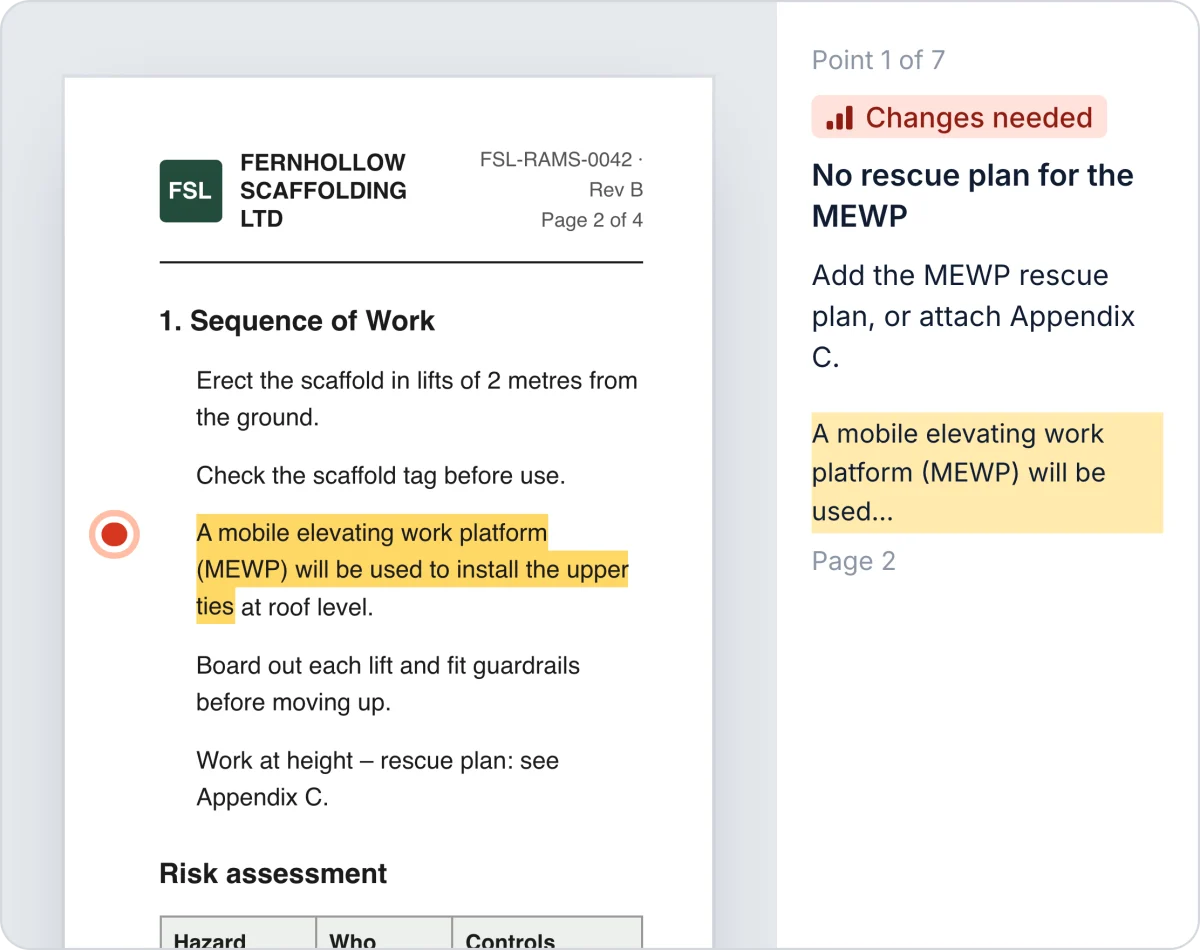
Working at height RAMS template
A blank working at height RAMS to fill in: job details, method statement, risk assessment and briefing record.
Risk assessment and method statement
Working at height RAMS
- Company
- left blank to fill in
- Site and work area
- left blank to fill in
- Planned dates
- left blank to fill in
- In charge on site
- left blank to fill in
- Team
- left blank to fill in
Method statement
- 1
- 2
- 3
- 4
- 5
- 6
Risk assessment
| Hazard | Who might be harmed and how | Controls in place | Further action |
|---|---|---|---|
Working at height RAMS example
The same RAMS, filled in for one job.
Risk assessment and method statement
Working at height, Second floor offices, 14 Mill Street, Stockport
Risk assessment
People entering the work area or tripping over materials
Workers, occupants and visitors
Mark or barrier the active work area. Store tools and materials away from access routes.
People using the building or passing by walking into the work or over what it leaves
Occupants, visitors, members of the public and workers
Keep the barriers and signs up while the work is active. Give people a clear way round where their normal route is blocked.
Tools and materials falling onto people below
People below
Bring waste down by hand or in bags. Never throw it. Keep the exclusion zone up until the last item is down.
A defect or unlocked section makes the ladder fail or move
The ladder user
Use a ladder suited to the job and the user.
A slipping base, wrong angle or unlocked ladder causes a fall
The ladder user and people below
Never stand a ladder on boxes, pallets or loose packing. Keep doors and routes controlled.
Falling from the ladder or steps; tools or tins dropped on people below
The person working from it, if the feet slip or they overreach to one side. Anyone passing or working under the ladder while it is in use.
Secure the equipment where it could move. Keep the base and area below clear.
A lost handhold or turned body causes a fall
The ladder user
Keep both hands available for climbing when moving between levels.
A stepladder tips or twists when the user works side-on or with both hands
The ladder user
Keep two feet and your body supported by the stepladder.
Overreaching, force or heavy handling pulls the user off balance
The ladder user
Reposition from the ground instead of leaning sideways. Use a guarded platform for force or bulky work.
The wrong parts or sequence cause a fall or tower collapse
Tower users and people below
Keep the manual with the tower information. Stop if the configuration is not covered.
A hurt person is left on the platform with no way of getting them down
Tower users and rescuers
Do not rely on the fire service as the rescue plan.
Soft, sloping or improvised support overturns the tower
Tower users and people nearby
Check the base before climbing. Keep within the maker’s height and loading limits.
An unguarded platform, falling part or wrong sequence causes a fall or collapse
Tower assemblers and people below
Use competent people and matching components. Stop if the configuration is not covered.
A defect in the assembled tower is missed before use
Tower users and people below
Keep it out of use until the inspection is complete. Recheck after it has been moved or altered, or after anything that could have affected it.
Falling from the tower platform; the tower overturning; tools or materials dropped from the platform
The person on the platform, where a guardrail or toe board is missing or was never fitted. Anyone on or beside the tower, if it is moved with people or materials on it, or built without its stabilisers. Anyone passing or working underneath.
Fit the required guardrails, braces and stabilisers. Move the tower only with nobody and nothing on it. Keep the area around the tower controlled.
A fall or dropped item injures the tower user or people below
Tower users and people below
Do not climb guardrails or add boxes, ladders or loose platforms. Keep the area below controlled.
An occupied or unstable tower overturns or strikes people and services
Tower movers and nearby people
Push or pull from the base only. Keep people clear of the route.
A fall or falling part while the tower comes down
Tower assemblers and people below
Use competent people. Do not leave a part-dismantled tower where someone can climb it.
Debris, tools or unfinished work left in the area
Workers, occupants and visitors
Remove waste by the agreed route. Record and protect any unfinished work.
Working at height, Second floor offices, 14 Mill Street, Stockport
- Company
- Hollins & Reed Contracting Ltd
- Site and work area
- Second floor offices, 14 Mill Street, Stockport
- Planned dates
- 12 to 14 October 2026
- In charge on site
- Dan Hollins
- Team
- Two operatives: Dan Hollins leads and checks the tower and stepladder each morning; Priya Shah works with him.
Method statement
- 1Set up the work areaConfirm the work area and scope before starting. Keep other people outside the active work area. Keep entrances and escape routes clear.
- 2Keep people clear of the workAgree how people get past or around the work while it is going on. Put barriers or signs where a route crosses the work. Do not leave open work unattended.
- 3Stop things falling on people belowKeep people out of the area below the work so nobody walks under the tools and materials. Keep toe boards and guards in place on any platform, and lanyard tools where you can.
- 4Check the ladder before useCheck the feet, rungs, steps, locks, labels and visible condition before climbing. Remove damaged equipment from use.
- 5Set the ladder securelyPut it on firm, level support with a strong upper resting point. For a leaning ladder, use the 1-in-4 angle and secure it against slipping. Open stepladders fully and lock them before climbing.
- 6Use the ladder or stepsCheck the ladder or steps before use. Place them on firm, level ground. Keep three points of contact while climbing. Reposition them instead of overreaching. Do not carry loose tools or tins up; hand them up or use a belt.
- 7Climb facing the ladderFace the rungs while climbing and keep three points of contact. Use a tool belt or pass tools up separately.
- 8Work from the stepladder facing the jobAll four feet down, locks on, facing the work. Keep a hand on. Both hands for a moment only: rest your body against the steps.
- 9Keep the task within reachUse only light tools and materials. Keep one hand on the ladder while you work. Both hands needed for more than a moment: use a tower or platform. Stay off the top three rungs and keep your belt buckle within the stiles. Descend before moving the ladder.
- 10Use the tower manualMatch every frame, brace, platform, guardrail and stabiliser to this job's system. Use trained people and do not improvise missing parts.
- 11Plan how to get someone downBefore anyone climbs, assembly included, agree how someone hurt or taken ill on the platform is brought down and who does it. Everyone using the tower knows the plan.
- 12Set the tower on a firm baseSupport locked castors or base plates correctly on a firm, level floor or ground. Fit stabilisers or outriggers when the manual requires them. Never use bricks as packing.
- 13Assemble the tower safelyWhen your team assembles it, follow the 3T or advance guard rail sequence from the manual, so nobody stands on an unguarded platform. Keep the area below controlled.
- 14Check the complete towerBefore use, check the platform, guardrails, toe boards, access, braces, wheels and stabilisers. A competent person inspects it after assembly, and at least every 7 days where someone could fall 2 m or more. The inspector reports before the end of the shift and gives a copy within 24 hours. Keep the report.
- 15Use the mobile towerFollow the supplier instructions for any build or change. Check the tower before first use and after it is moved. Lock the wheels before using the platform. Climb using the internal access provided. Keep the toe boards on and tools and materials inside the guardrails.
- 16Work inside the tower protectionUse the internal access provided and keep guardrails and toe boards in place. Keep tools and materials within the platform loading.
- 17Move the tower emptyRemove people and materials before moving it. Reduce it to a platform height of 4.0 m or less, raise the stabilisers no more than 25 mm, and check the route, ground and overhead clearance. Do not move it where wind or a draught can catch it. Check it again after the move.
- 18Take the tower down in sequenceTake the tower down to the manual, with the same guard rail method in reverse. Lower parts by hand, keep the area below controlled and secure them for storage.
- 19Clear and hand back the areaRemove tools, waste and unused materials. Check the area is clean and ready to use. Tell the customer or whoever runs the site when the work is complete.
What a working at height RAMS covers
Working from a ladder, stepladder, podium, mobile tower, MEWP or a scaffold someone else has put up. Not covered: erecting, altering or dismantling a scaffold.
Falls from height caused 97 of 186 construction worker deaths in five years (HSE, 2021/22–2025/26p). See the figures
- Ladder/steps
- Mobile tower use
- MEWP use
- Podium use
- Existing scaffold use
Suggested steps and hazards for working at height
Suggested for MEWP use before any questions are answered.
Stop things falling on people below
- Keep people out of the area below the work so nobody walks under the tools and materials.
- Keep toe boards and guards in place on any platform, and lanyard tools where you can.
Hazard
Tools and materials falling onto people below
Who might be harmed and how
People below
Controls in place
- Bring waste down by hand or in bags. Never throw it.
- Keep the exclusion zone up until the last item is down.
Falling objects are a leading cause of harm to the public near construction.
HSE: Protecting the public Use a trained familiarised operator
- Use an operator trained for the MEWP category and familiar with this job's make and model.
- Check the training and familiarisation records.
Hazard
An unfamiliar operator overturns, collides or becomes trapped.
Who might be harmed and how
The operator and people nearby
Controls in place
- Follow the machine manual and site traffic controls.
- Supervise an unfamiliar operator.
Category training and machine familiarisation support safe control of the MEWP.
Mobile elevating work platforms (MEWPs) Check the MEWP before use
- Check the examination status, controls, tyres, alarms, guardrails, gate and emergency lowering system.
- Use only this job's machine within its load and wind limits.
Hazard
A defect or overloaded MEWP fails, overturns or leaves someone stranded.
Who might be harmed and how
The operator and people nearby
Controls in place
- Remove a defective machine from use.
- Keep the manual and examination record available.
The pre-use check and examination status show whether the machine is fit to operate.
Mobile elevating work platforms (MEWPs)
What the builder asks about working at height
Your answers decide which steps, hazards and controls it suggests.
The job
- What work will you do from the platform?
Where
- Is the MEWP position ready?
- Is the tower position ready?
- Is the podium position ready?
How it’s done
- How high is the work, and what is the ground like?
- Which ladder or steps will you use?
- Which tower work will your team do?
- Which MEWP will you use?
- What will your team do to the scaffold?
- Will anyone touch a light, cable or other electrical item from the ladder?
- What will you do with the ladder?
- What will you do from the podium?
- What work and load does the handover allow?
What you’ve been told
- Which named podium and manual do you have?
What your working at height RAMS includes
Method statement
The work in order, step by step.
Risk assessment
Each hazard, who could be harmed, the controls in place and any further action.
The method statement and risk assessment in one A4 PDF. Your logo on Pro and Team.
What the law asks for
What a RAMS is
A risk assessment and method statement. The risk assessment records what could cause harm on the job, who could be harmed and how, and the controls that keep the risk down. The method statement sets out how the work will be done, step by step, in the order it happens.
A client or main contractor will usually ask for one before you start. RAMS is a site term, not a legal one: the law asks for the risk assessment and for the work to be planned, and a method statement is the usual way to show that plan for one job.
Learning to write one
The RAMS guide works through one trench job. It shows how to say which job it covers, name who each step could harm and put each control before the work it protects.
What the law asks for
- Employers, and self-employed people doing construction work, must make a suitable and sufficient assessment of the risks to their own people and to anyone else affected by the work (Management of Health and Safety at Work Regulations 1999, regulation 3).
- An employer with five or more employees must record the significant findings and any group of employees it finds especially at risk. The assessment must be reviewed if there is reason to think it is no longer valid, or the work has changed significantly.
- Every contractor must plan, manage and monitor its work so that, so far as is reasonably practicable, it is done without risks to health and safety, and must give its workers the information and instructions they need, including the hazards the risk assessment found (Construction (Design and Management) Regulations 2015, regulation 15).
HSE guidance: the steps to manage risk and what contractors must do under CDM. This is the law in Great Britain; Northern Ireland has its own equivalent regulations.
What the builder does
You choose the work and answer questions about how the job will be done, such as what you will stand on and what else is going on nearby. Your answers decide which steps, hazards and controls it suggests.
Many suggestions link to the HSE guidance they draw on. Your work is kept in this browser and, signed in, on your account with its photos; the PDF is made on your device. A briefing you send to phones goes through your account.
Separate documents
A COSHH assessment, lifting plan, permit to work, asbestos survey and the principal contractor’s construction phase plan are separate from the RAMS.
Reviewing a RAMS before work starts
RAMS review reads a RAMS PDF, yours before you send it or one a subcontractor sends you, and lists the points to raise, each marked on the page it comes from. Quick reviews are free.