
Liquid roofing RAMS Builder
Liquid roofing risk assessment and method statement
Checking this browser for your work…
RAMS review
Check a RAMS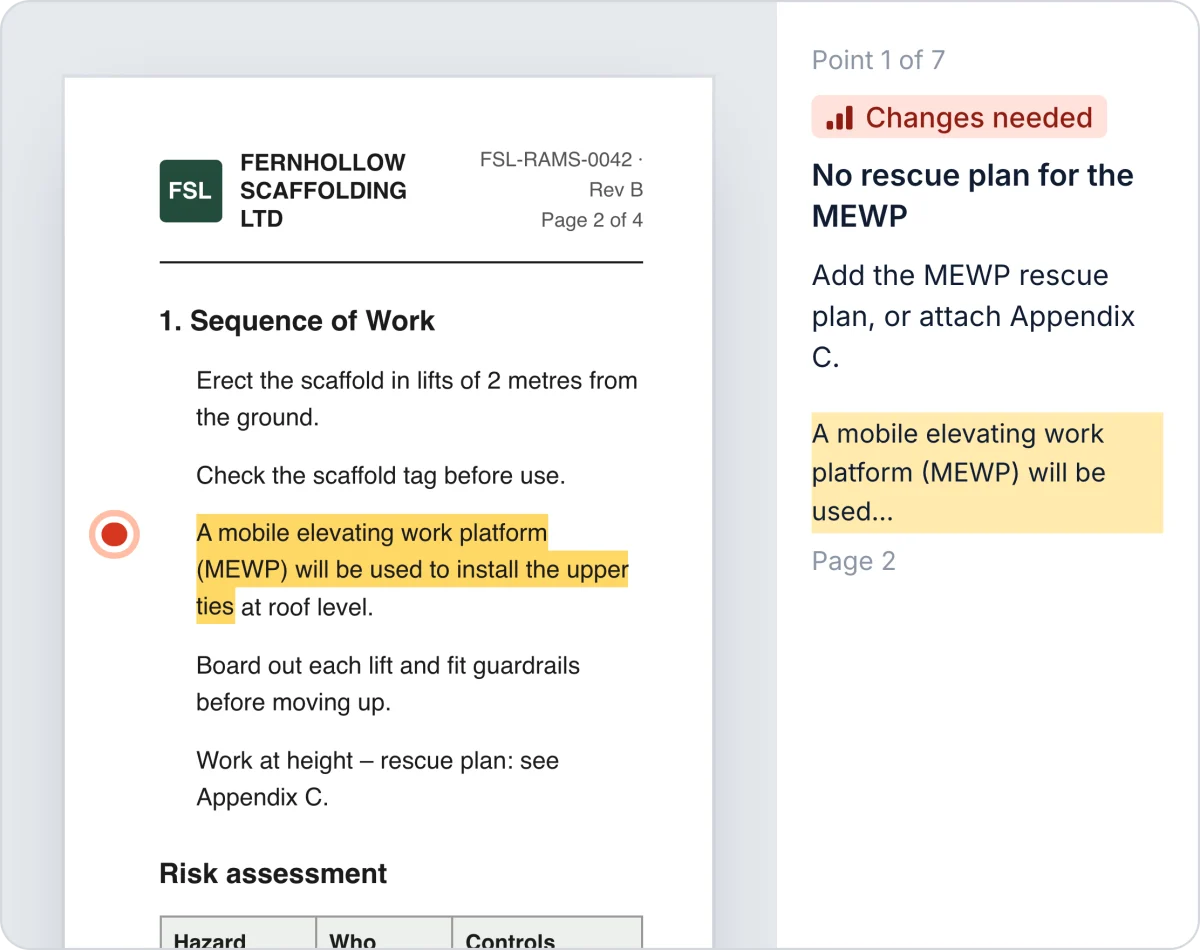
Liquid roofing RAMS template
A blank liquid roofing RAMS to fill in: job details, method statement, risk assessment and briefing record.
Risk assessment and method statement
Liquid roofing RAMS
- Company
- left blank to fill in
- Site and work area
- left blank to fill in
- Planned dates
- left blank to fill in
- In charge on site
- left blank to fill in
- Team
- left blank to fill in
Method statement
- 1
- 2
- 3
- 4
- 5
- 6
Risk assessment
| Hazard | Who might be harmed and how | Controls in place | Further action |
|---|---|---|---|
Liquid roofing RAMS example
The same RAMS, filled in for one job.
Risk assessment and method statement
Liquid roofing, Rear flat roof, 8 Weaver Street Offices, Stockport
Risk assessment
People entering the work area or tripping over materials
Workers, occupants and visitors
Mark or barrier the active work area. Store tools and materials away from access routes.
A system is used outside its tested or intended application
Applicators and building occupants
Use the manufacturer's instructions. Stop if the product or its use is unclear.
Poor adhesion or trapped defects cause waterproofing failure
Applicators and building occupants
Follow the system manufacturer's preparation method. Do not coat an unaccepted surface.
Breathing asbestos fibres from old boards, sheets, sealants or insulation
The team and anyone in the building
Do not cut, drill or break any material until it is confirmed asbestos free. Licensed work is not for this method; hand it to a licensed contractor.
Wind catches the liquid materials and wet roof surfaces or blows someone off balance at height
The team and people below
Agree a wind limit for this work and check the forecast before you start. Tie down or take in loose materials before you leave.
Tools, buckets and roof details falling onto people below
People below
Bring waste down by hand or in bags. Never throw it. Keep the exclusion zone up until the last item is down.
Falling from a scaffold that has been altered; materials falling from the scaffold
Anyone working on the lift, where a guardrail, board or tie has been taken out to get the work done. Anyone passing or working underneath, including the public where the scaffold is over a footpath.
Never remove boards, ties, guardrails or bracing; ask the scaffolding contractor to alter it. Report damage or a missing tag and keep off until it is checked. Fit brick guards or netting where materials could fall on people below.
A load falls from the hoist onto someone below
People below the hoist
Secure the roof materials before the lift. One person controls the lift and everyone can hear them.
Contamination or wrong primer prevents the coating bonding
Applicators and building occupants
Use the product data and compatible materials. Do not apply over dust, standing water or uncured preparation.
Skin, eye or breathing exposure and an incomplete waterproof coating
Applicators and people nearby
Use the product SDS and specified PPE. Keep non-essential people out of the wet work area.
People damage the wet coating or fall on a contaminated roof surface
Applicators, other trades and building occupants
Mark and barrier the wet work area. Follow the product curing and protection time.
Debris, tools or unfinished work left in the area
Workers, occupants and visitors
Remove waste by the agreed route. Record and protect any unfinished work.
Liquid roofing, Rear flat roof, 8 Weaver Street Offices, Stockport
- Company
- Hollins & Reed Roofing Ltd
- Site and work area
- Rear flat roof, 8 Weaver Street Offices, Stockport
- Planned dates
- 12 to 13 October 2026
- In charge on site
- Dan Hollins
- Team
- Two roofers: Dan Hollins leads and applies; Priya Shah prepares and hoists.
Method statement
- 1Set up the work areaConfirm the work area and scope before starting. Keep other people outside the active work area. Keep entrances and escape routes clear.
- 2Check this job's systemConfirm the product, intended roof use and current approval before opening it. Keep the product information and safety data with the RAMS.
- 3Check the roof surfaceInspect the roof for soundness, cleanliness, moisture and anything that could stop the system bonding. Record the condition and any repair or compatibility decision before coating.
- 4Check for asbestos before you disturb anythingCheck the asbestos survey covers exactly what you will disturb, to the full depth. Register only, or nothing: get a refurbishment survey or a sample first. Read what it says about the existing roof, insulation and old waterproofing. No survey, or a material you do not recognise: stop and get it checked.
- 5Check the weather before you startDo not lift or fix liquid materials and wet roof surfaces in strong wind. Stop in heavy rain, ice or lightning.
- 6Stop things falling on people belowKeep people out of the area below the work so nobody walks under the tools, buckets and roof details. Keep toe boards and guards in place on any platform, and lanyard tools where you can.
- 7Work from the scaffoldCheck the scaffold tag or handover shows an inspection within the last 7 days. Use only the lifts and access that were handed over. Keep materials within the loading the scaffold was built for. Keep off in high wind or ice, or when sheeting has come loose.
- 8Use the hoistCheck the hoist's thorough examination report is in date and it can take the weight. Keep people out from underneath while a load is up.
- 9Clean and prime as specifiedClean the roof and carry out any specified adhesion test. Use primer only where the system requires it, then keep the prepared surface clean and dry.
- 10Apply the liquid systemMix and apply this job's system with its specified tool, coat thickness and sequence. Keep within the stated overcoat and curing times and do not add unapproved materials.
- 11Protect the wet roof until it curesKeep people and other trades off the coating, or use only the agreed protected route. Protect the finished area from rain, dirt and damage until the system says it can be used.
- 12Clear and hand back the areaRemove tools, waste and unused materials. Check the area is clean and ready to use. Tell the customer or whoever runs the site when the work is complete.
What a liquid roofing RAMS covers
Applying a liquid roof system to the maker's instructions, and detailing upstands, outlets, penetrations and edges. Not covered: stripping the existing covering.
- Apply liquid roof
- Liquid roof detailing
Suggested steps and hazards for liquid roofing
Suggested for apply liquid roof before any questions are answered.
Check this job's system
- Confirm the product, intended roof use and current approval before opening it.
- Keep the product information and safety data with the RAMS.
Hazard
A system is used outside its tested or intended application
Who might be harmed and how
Applicators and building occupants
Controls in place
- Use the manufacturer's instructions.
- Stop if the product or its use is unclear.
This job's system sets the safe preparation, application and curing method.
HSE: Safety data sheets Check the roof surface
- Inspect the roof for soundness, cleanliness, moisture and anything that could stop the system bonding.
- Record the condition and any repair or compatibility decision before coating.
Hazard
Poor adhesion or trapped defects cause waterproofing failure
Who might be harmed and how
Applicators and building occupants
Controls in place
- Follow the system manufacturer's preparation method.
- Do not coat an unaccepted surface.
Liquid waterproofing only works when the surface is suitable and prepared for that system.
LRWA design guide for specifiers Check the weather before you start
- Do not lift or fix liquid materials and wet roof surfaces in strong wind.
- Stop in heavy rain, ice or lightning.
- Rest in the shade in hot weather.
Hazard
Wind catches the liquid materials and wet roof surfaces or blows someone off balance at height
Who might be harmed and how
The team and people below
Controls in place
- Agree a wind limit for this work and check the forecast before you start.
- Tie down or take in loose materials before you leave.
Wind is the main weather cause of falls and dropped loads in outside work at height.
HSE: Work at height
What the builder asks about liquid roofing
Your answers decide which steps, hazards and controls it suggests.
The job
- What liquid system is named?
- What detail are you treating?
Where
- What has been confirmed about the roof surface?
- How will the roof stay clear while it cures?
- Is the building older than the year 2000? Older buildings can have asbestos in them.
- What pipes or cables run through or below the roof around the detail?
How it’s done
- What will you stand on to reach the work?
- What goes into the coating at this detail?
- How will the roof materials get to the work?
What you’ve been told
- How will you check the finished detail?
What your liquid roofing RAMS includes
Method statement
The work in order, step by step.
Risk assessment
Each hazard, who could be harmed, the controls in place and any further action.
The method statement and risk assessment in one A4 PDF. Your logo on Pro and Team.
What the law asks for
What a RAMS is
A risk assessment and method statement. The risk assessment records what could cause harm on the job, who could be harmed and how, and the controls that keep the risk down. The method statement sets out how the work will be done, step by step, in the order it happens.
A client or main contractor will usually ask for one before you start. RAMS is a site term, not a legal one: the law asks for the risk assessment and for the work to be planned, and a method statement is the usual way to show that plan for one job.
What the law asks for
- Employers, and self-employed people doing construction work, must make a suitable and sufficient assessment of the risks to their own people and to anyone else affected by the work (Management of Health and Safety at Work Regulations 1999, regulation 3).
- An employer with five or more employees must record the significant findings and any group of employees it finds especially at risk. The assessment must be reviewed if there is reason to think it is no longer valid, or the work has changed significantly.
- Every contractor must plan, manage and monitor its work so that, so far as is reasonably practicable, it is done without risks to health and safety, and must give its workers the information and instructions they need, including the hazards the risk assessment found (Construction (Design and Management) Regulations 2015, regulation 15).
HSE guidance: the steps to manage risk and what contractors must do under CDM. This is the law in Great Britain; Northern Ireland has its own equivalent regulations.
What the builder does
You choose the work and answer questions about how the job will be done, such as what you will stand on and what else is going on nearby. Your answers decide which steps, hazards and controls it suggests.
Many suggestions link to the HSE guidance they draw on. Your work is kept in this browser and, signed in, on your account with its photos; the PDF is made on your device. A briefing you send to phones goes through your account.
Separate documents
A COSHH assessment, lifting plan, permit to work, asbestos survey and the principal contractor’s construction phase plan are separate from the RAMS.
Reviewing a RAMS before work starts
RAMS review reads a RAMS PDF, yours before you send it or one a subcontractor sends you, and lists the points to raise, each marked on the page it comes from. Quick reviews are free.