
Dewatering RAMS Builder
Dewatering risk assessment and method statement
Checking this browser for your work…
RAMS review
Check a RAMS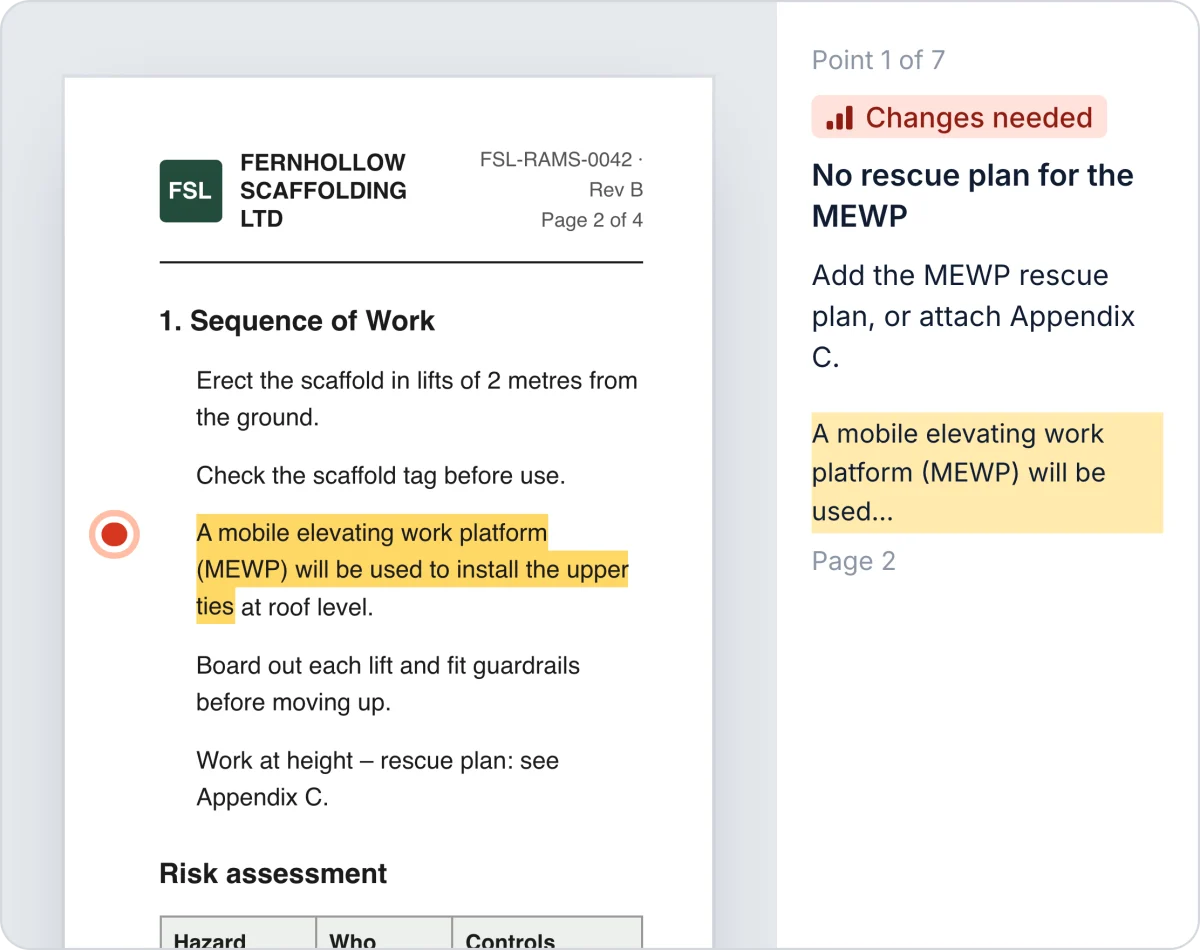
Dewatering RAMS template
A blank dewatering RAMS to fill in: job details, method statement, risk assessment and briefing record.
Risk assessment and method statement
Dewatering RAMS
- Company
- left blank to fill in
- Site and work area
- left blank to fill in
- Planned dates
- left blank to fill in
- In charge on site
- left blank to fill in
- Team
- left blank to fill in
Method statement
- 1
- 2
- 3
- 4
- 5
- 6
Risk assessment
| Hazard | Who might be harmed and how | Controls in place | Further action |
|---|---|---|---|
Dewatering RAMS example
The same RAMS, filled in for one job.
Risk assessment and method statement
Dewatering, Plot 6, Wharf Lane, Stockport: drainage trench
Risk assessment
People entering the work area or tripping over materials
Workers, occupants and visitors
Mark or barrier the active work area. Store tools and materials away from access routes.
Collapse, settlement or pollution caused by uncontrolled dewatering
The excavation team and people nearby
Stop if the water or stability risk is not understood. Keep the agreed support arrangement unchanged.
Dirty water going into a drain or stream and killing fish, with a fine to follow
The pump team and the environment
Only the drain or tank you were told to use, nothing else. Stop pumping if the water changes colour or smell.
Hitting a live cable or gas pipe causes shock, fire or gas escape
The person doing the work and everyone nearby
Check again wherever the work moves. If you hit something, stop, keep clear and report it.
Wind catches the pumps, hoses and temporary barriers and blows them onto people nearby
The team and people nearby
Check the forecast before you start and agree when the wind stops the work. Tie down or take in loose materials before you leave.
Back and shoulder injury from carrying heavy or long items
Everyone handling materials
Use a trolley or sack truck on the flat where the load suits one. Where the work is up a level, hand items up or hoist them. Never carry them up a ladder.
A shock from a pump, lead or board standing in water
The pump team and anyone in the excavation
Only an electrician isolates, locks off and proves dead before anyone opens a pump or a board. Never lift a running pump by its cable, and never dry a damaged lead out and carry on.
A person is trapped or struck during unstable wet excavation work
The excavation team and plant operators
Use the agreed access and exclusion arrangement. Stop if the water level or sides change unexpectedly.
Erosion, flooding or loss of excavation stability
The excavation team
Inspect the sump, pump and discharge hose before use. Do not let pump-out change the support arrangement.
A pump failure or uncontrolled water level change makes the excavation unsafe
The pump team and excavation workers
Keep a safe stop and backup arrangement ready. Stop and report a change the method does not cover.
The amount of water coming out creeping up and nobody noticing
The pump team and the environment
Keep the readings with the job paperwork. Tell the site straight away if the reading jumps.
Debris, tools or unfinished work left in the area
Workers, occupants and visitors
Remove waste by the agreed route. Record and protect any unfinished work.
Dewatering, Plot 6, Wharf Lane, Stockport: drainage trench
- Company
- Hollins & Reed Groundworks Ltd
- Site and work area
- Plot 6, Wharf Lane, Stockport: drainage trench
- Planned dates
- 12 to 14 October 2026
- In charge on site
- Dan Hollins
- Team
- Two operatives: Dan Hollins leads and checks the area each morning; Priya Shah works with him.
Method statement
- 1Set up the work areaConfirm the work area and scope before starting. Keep other people outside the active work area. Keep entrances and escape routes clear.
- 2Check the dewatering methodRead the excavation and dewatering assessment before placing a pump. Check the water source, nearby structures and ground support are covered.
- 3Know where the water is going before you startFind out which drain or tank the water goes to, and that the site is allowed to put it there. If you cannot say the water is clean, pump it into a tank or settlement bag instead of a drain.
- 4Find and isolate hidden servicesFind cables and pipes before you disturb anything: drawings, then a detector. Mark what you find. Not sure what is there? Turn the supply off, or do not start. Have cables and gas isolated by the right person and prove them dead before you start.
- 5Check the weather before you startStop handling pumps, hoses and temporary barriers when the wind is strong enough to catch them. Stop in heavy rain, ice or lightning.
- 6Carry the pumps, hoses and barriers safelyPlan the route, clear it, and get help with anything long or heavy. Store materials close to the work so nobody carries further than they need to.
- 7Keep the pump power safe in the wetRun pumps off 110 volt or through an RCD, with leads and plugs checked and in date. Keep joints and boards up out of the water and off the ground.
- 8Keep people and plant out while pumpingKeep people and powered plant out of the excavation while the dewatering control is operating. Reassess before anyone enters or plant is used in the excavation.
- 9Channel water to a stable sumpLead entering water to a stable sump and position the pump so it cannot undermine the excavation. Keep the excavation protected while water is removed.
- 10Run the pump under controlCheck the pump, hose, power supply and connections before starting. Start it in the agreed sequence and watch the water level and excavation sides.
- 11Write down how much you pump outRead the meter at the same time every day while the pump is running and write it in the job file.
- 12Clear and hand back the areaRemove tools, waste and unused materials. Check the area is clean and ready to use. Tell the customer or whoever runs the site when the work is complete.
What a dewatering RAMS covers
Pumping water out of an excavation to an agreed discharge point, and diverting a stream or ditch past the works. Not covered: wellpoint and deep well systems.
- Pump water from an excavation
- Bypass a watercourse flow
Suggested steps and hazards for dewatering
Suggested for pump water from an excavation before any questions are answered.
Check the dewatering method
- Read the excavation and dewatering assessment before placing a pump.
- Check the water source, nearby structures and ground support are covered.
Hazard
Collapse, settlement or pollution caused by uncontrolled dewatering
Who might be harmed and how
The excavation team and people nearby
Controls in place
- Stop if the water or stability risk is not understood.
- Keep the agreed support arrangement unchanged.
Pumping can change excavation stability and nearby ground, so its effect must be checked first.
HSE: Excavations Know where the water is going before you start
- Find out which drain or tank the water goes to, and that the site is allowed to put it there.
- If you cannot say the water is clean, pump it into a tank or settlement bag instead of a drain.
Hazard
Dirty water going into a drain or stream and killing fish, with a fine to follow
Who might be harmed and how
The pump team and the environment
Controls in place
- Only the drain or tank you were told to use, nothing else.
- Stop pumping if the water changes colour or smell.
Putting the wrong water down a drain is a criminal offence, and the site carries it.
Temporary dewatering from excavations to surface water: RPS 261 Keep the pump power safe in the wet
- Run pumps off 110 volt or through an RCD, with leads and plugs checked and in date.
- Keep joints and boards up out of the water and off the ground.
Hazard
A shock from a pump, lead or board standing in water
Who might be harmed and how
The pump team and anyone in the excavation
Controls in place
- Only an electrician isolates, locks off and proves dead before anyone opens a pump or a board.
- Never lift a running pump by its cable, and never dry a damaged lead out and carry on.
Wet ground gives the current a path straight through whoever is stood in it.
HSE: Electricity, systems in buildings
What the builder asks about dewatering
Your answers decide which steps, hazards and controls it suggests.
The job
- What water will the pump remove?
- What flow will the bypass carry?
Where
- Where will the water go?
- Could pumping affect the ground?
- What pipes or cables run in the ground where you will dig a sump or channel?
How it’s done
- What will you stand on to reach the work?
- How will you keep the flow moving?
- How will the pumps, hoses and barriers get to the work?
What you’ve been told
- Is the paperwork in for working in the stream?
What your dewatering RAMS includes
Method statement
The work in order, step by step.
Risk assessment
Each hazard, who could be harmed, the controls in place and any further action.
The method statement and risk assessment in one A4 PDF. Your logo on Pro and Team.
What the law asks for
What a RAMS is
A risk assessment and method statement. The risk assessment records what could cause harm on the job, who could be harmed and how, and the controls that keep the risk down. The method statement sets out how the work will be done, step by step, in the order it happens.
A client or main contractor will usually ask for one before you start. RAMS is a site term, not a legal one: the law asks for the risk assessment and for the work to be planned, and a method statement is the usual way to show that plan for one job.
Learning to write one
The RAMS guide works through one trench job. It shows how to say which job it covers, name who each step could harm and put each control before the work it protects.
What the law asks for
- Employers, and self-employed people doing construction work, must make a suitable and sufficient assessment of the risks to their own people and to anyone else affected by the work (Management of Health and Safety at Work Regulations 1999, regulation 3).
- An employer with five or more employees must record the significant findings and any group of employees it finds especially at risk. The assessment must be reviewed if there is reason to think it is no longer valid, or the work has changed significantly.
- Every contractor must plan, manage and monitor its work so that, so far as is reasonably practicable, it is done without risks to health and safety, and must give its workers the information and instructions they need, including the hazards the risk assessment found (Construction (Design and Management) Regulations 2015, regulation 15).
HSE guidance: the steps to manage risk and what contractors must do under CDM. This is the law in Great Britain; Northern Ireland has its own equivalent regulations.
What the builder does
You choose the work and answer questions about how the job will be done, such as what you will stand on and what else is going on nearby. Your answers decide which steps, hazards and controls it suggests.
Many suggestions link to the HSE guidance they draw on. Your work is kept in this browser and, signed in, on your account with its photos; the PDF is made on your device. A briefing you send to phones goes through your account.
Separate documents
A COSHH assessment, lifting plan, permit to work, asbestos survey and the principal contractor’s construction phase plan are separate from the RAMS.
Reviewing a RAMS before work starts
RAMS review reads a RAMS PDF, yours before you send it or one a subcontractor sends you, and lists the points to raise, each marked on the page it comes from. Quick reviews are free.