
Groundworks RAMS Builder
Groundworks risk assessment and method statement
Checking this browser for your work…
RAMS review
Check a RAMS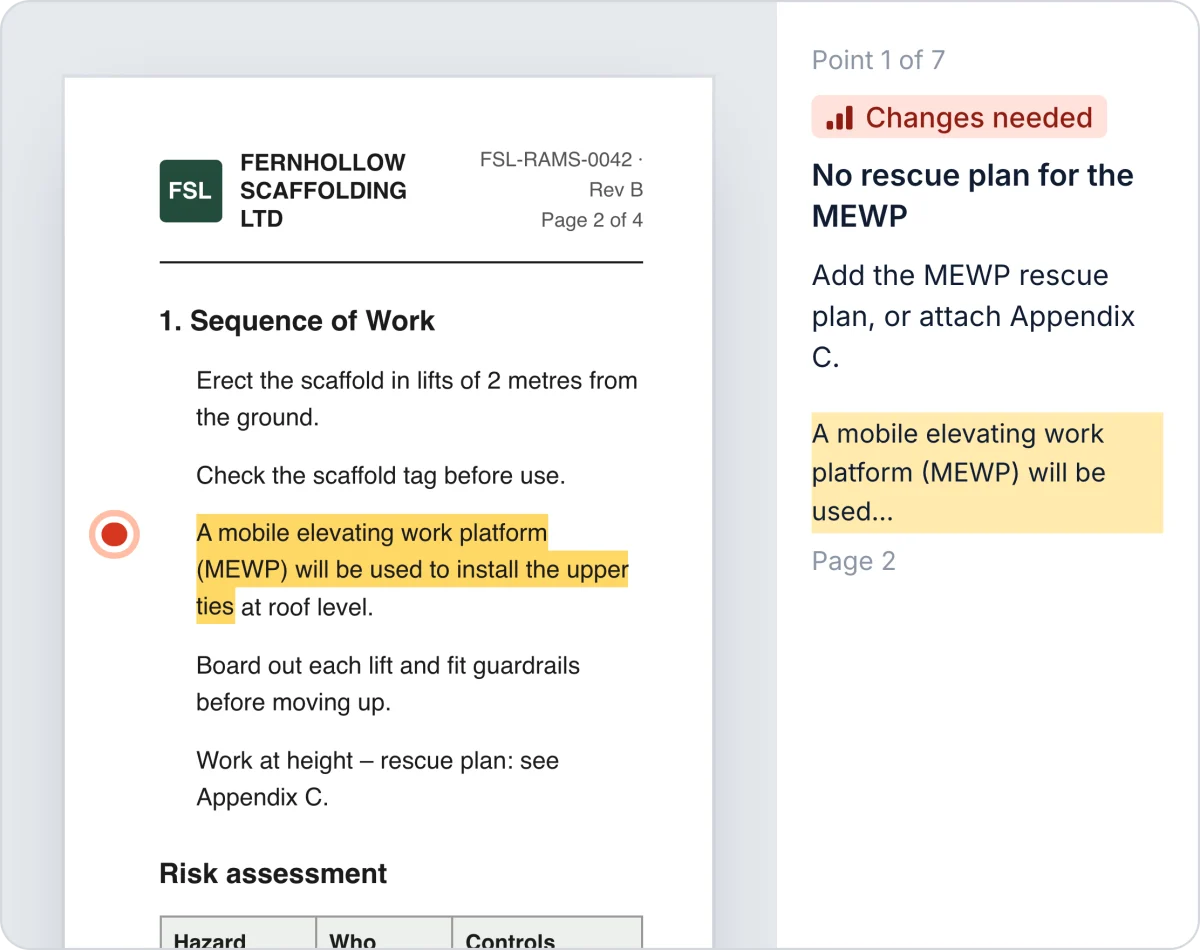
Groundworks RAMS template
A blank groundworks RAMS to fill in: job details, method statement, risk assessment and briefing record.
Risk assessment and method statement
Groundworks RAMS
- Company
- left blank to fill in
- Site and work area
- left blank to fill in
- Planned dates
- left blank to fill in
- In charge on site
- left blank to fill in
- Team
- left blank to fill in
Method statement
- 1
- 2
- 3
- 4
- 5
- 6
Risk assessment
| Hazard | Who might be harmed and how | Controls in place | Further action |
|---|---|---|---|
Groundworks RAMS example
The same RAMS, filled in for one job.
Risk assessment and method statement
Groundworks, Side access road, Canal Side Business Park, Stockport
Risk assessment
People entering the work area or tripping over materials
Workers, occupants and visitors
Mark or barrier the active work area. Store tools and materials away from access routes.
Hitting a buried cable or gas pipe causes shock, burns or a gas escape
The person doing the work and everyone nearby
If a cable is struck, the driver stays in the cab. If gas is struck, get everyone away, put out ignition sources within 5 m and ring 0800 111 999.
Back and shoulder injury from carrying heavy or long items
Everyone handling materials
Use a trolley or sack truck on the flat where the load suits one.
The excavation side collapsing under spoil, plant or vehicle loading
The dig team, drivers and people near the excavation
Set a clear edge exclusion area. Do not park or tip close to the sides.
A moving excavator striking or trapping a person
The operator, dig team and people passing
Keep pedestrians out of the operating area. Stop the machine before anyone enters its working area.
Breathing asbestos fibres from buried sheet, pipes or old fill
The dig team and anyone downwind
Do not move or break suspect material; get it checked first. Licensed work is not for this method; hand it to a licensed contractor.
Ground movement, flooding or a nearby structure being undermined
The dig team, nearby workers and the public
Keep pumps, traffic and plant within the assessed arrangement. Recheck the excavation after a change in conditions.
Laying a duct on the wrong route or too close to an existing service
The duct team and service owners
Use the current drawing and named confirmation. Stop if the detail is missing or conflicts with site evidence.
Striking a buried service while starting the excavation
The dig team and people nearby
Use the service records and survey marks together. Keep the work stopped while an unexpected service is identified.
Plant strikes a service, or the dig undermines a wall, scaffold or footing
The dig team and anyone nearby
Check the quick hitch pin is in before the bucket moves. Check the dig against nearby walls and scaffold before it starts.
A person falling into the open excavation
The dig team, other trades and people passing
Check the barrier after work or weather changes. Do not leave an open excavation unprotected.
The excavation sides collapsing and burying someone
Anyone working in or near the excavation
Have the angle set by a competent person. Stop if the ground or excavation is not as assessed.
Burial or injury in an excavation that has moved since the last check
Anyone working in or near the excavation
Record the inspection and correct faults before work resumes. Keep people out while a defect remains.
Damaging an existing service or creating a duct that cannot be used later
The duct team and service owners
Use the owner’s separation and protection detail. Stop when the planned clearance cannot be achieved.
A blocked, flooded or unidentifiable duct that cannot take the future service
The duct team and the next contractor
Use the specified end seals and labels. Check the handover items before backfill.
A joint separates, leaks or lets soil into the duct
The duct team and the next contractor
Use only compatible couplers and seals. Reject damaged or incomplete joints.
A duct being lost or installed differently from the record
The duct team and whoever uses the duct later
Record what was actually laid, not just the design. Keep the handover record with the job file.
Burying faulty work or losing the evidence needed to repair it
The backfill team and the service owner
Use this job's release arrangement. Keep the inspection record with the RAMS.
Silt or contaminated water polluting a drain or watercourse
The backfill team, the public and the environment
Stop pumping if the discharge route is not controlled. Report a spill or unexpected contamination at once.
Crushing, pulling or damaging a service while fill is placed
The backfill team and the service owner
Use the specified material and sequence. Stop and report damage before covering it.
Settlement, voids or later failure from poorly compacted fill
The backfill team and people using the finished ground
Follow the actual fill specification. Record tests or acceptance as the job requires.
Debris, tools or unfinished work left in the area
Workers, occupants and visitors
Remove waste by the agreed route. Record and protect any unfinished work.
Groundworks, Side access road, Canal Side Business Park, Stockport
- Company
- Hollins & Reed Groundworks Ltd
- Site and work area
- Side access road, Canal Side Business Park, Stockport
- Planned dates
- 12 to 14 October 2026
- In charge on site
- Dan Hollins
- Team
- Three operatives: Dan Hollins leads and drives the excavator; Priya Shah lays ducts and compacts; Sam Okoro is the banksman.
Method statement
- 1Set up the work areaConfirm the work area and scope before starting. Keep other people outside the active work area. Keep entrances and escape routes clear.
- 2Find and isolate hidden servicesFind buried cables and pipes before anyone digs: plans first, then a locator. Plans only show roughly where things are. Mark what you find. Not sure what is there? Do not dig.
- 3Carry the tools and materials safelyPlan the route, clear it, and get help with anything long or heavy. Store materials close to the work so nobody carries further than they need to.
- 4Keep spoil and plant off the edgePut spoil, materials and plant where their weight will not load the excavation edge. Keep the route beside the dig clear.
- 5Separate people from the excavatorBarrier the excavator’s working area and agree the pedestrian route. Use a trained operator and a marshaller where the method needs one.
- 6Watch for asbestos in the groundOld fill and demolition ground can hold asbestos cement sheet, fragments and old pipes. Ask for the site ground report or asbestos survey before you break ground. If you turn up cement sheet, rope lagging or anything you do not recognise, stop and cover it over.
- 7Control changes in the groundDeal with water, made ground, nearby structures and traffic in the temporary works plan. Stop if the ground moves, water rises or a nearby structure is affected.
- 8Confirm the current duct detailGet the owner or site drawing before setting out the run. Check the route against existing service information.
- 9Set out the dig against service marksCheck the excavation line against the plans and marks before breaking the surface. Stop if the service information and the ground do not agree.
- 10Dig to the marks, by hand near servicesDig trial holes by hand near services, with a safe digging method and the locator operator. Set spoil back from the edge and keep plant away from the sides. Nobody goes in until the sides are safe.
- 11Barrier the open excavationPut a substantial barrier around edges where people could fall. Keep it in place when the team leaves the excavation.
- 12Keep the sides to the set angleCut the sides back or step them to the angle named in this document before anyone goes in. Do not steepen them because the ground looks firm.
- 13Inspect the excavation before workHave a competent person inspect the excavation and support at the start of each shift. Inspect again after rain, frost or anything that could affect stability. Where supports or battering are used, write the report within 24 hours.
- 14Keep the new duct clear of servicesSet the duct to the specified route and separation from existing services. Do not change a bend or route to make it fit without approval.
- 15Keep the bore open and protectedCap accessible ends as the run is laid and keep soil and water out. Leave the draw rope and end labels required by the handover detail.
- 16Join the ducts with the compatible systemClean and join each duct with the couplers and method specified for that product. Check the joint is fully seated before the run is covered.
- 17Record the as-laid routeRecord the route, endpoints, bends and depth before the duct is covered. Give the record to the owner or next contractor.
- 18Get the excavation releasedCheck the inspection, any building control visit and any record the work needs before anything goes back in. Stop if a defect or missing record remains.
- 19Keep dirty water and silt out of drainsKeep spoil and wash water away from drains and watercourses. Use the site’s agreed controls for pumping, silt and contaminated water.
- 20Bed and cover services by handUse the owner’s bedding and cover detail around exposed pipes, ducts or cables. Keep hard or sharp fill away from the service, and put warning tape and tiles back above it.
- 21Compact each specified layerPlace the specified fill in the layers the job detail sets. Compact each layer to the required acceptance before adding the next.
- 22Clear and hand back the areaRemove tools, waste and unused materials. Check the area is clean and ready to use. Tell the customer or whoever runs the site when the work is complete.
What a groundworks RAMS covers
Finding buried services, shallow excavation by machine or hand, backfilling and compacting, and laying empty ducts. Not covered: drainage, and deep or supported excavations.
- Locate services
- Shallow excavate
- Backfill/compact
- Lay empty service ducts
Suggested steps and hazards for groundworks
Suggested for shallow excavate before any questions are answered.
Keep spoil and plant off the edge
- Put spoil, materials and plant where their weight will not load the excavation edge.
- Keep the route beside the dig clear.
Hazard
The excavation side collapsing under spoil, plant or vehicle loading
Who might be harmed and how
The dig team, drivers and people near the excavation
Controls in place
- Set a clear edge exclusion area.
- Do not park or tip close to the sides.
Keeping weight off the edge reduces the risk of the excavation side collapsing.
HSE: Excavations Watch for asbestos in the ground
- Old fill and demolition ground can hold asbestos cement sheet, fragments and old pipes.
- Ask for the site ground report or asbestos survey before you break ground.
- If you turn up cement sheet, rope lagging or anything you do not recognise, stop and cover it over.
Hazard
Breathing asbestos fibres from buried sheet, pipes or old fill
Who might be harmed and how
The dig team and anyone downwind
Controls in place
- Do not move or break suspect material; get it checked first.
- Licensed work is not for this method; hand it to a licensed contractor.
Asbestos cement pipes and demolition fill are common in ground around anything built before 2000.
HSE: Asbestos, actions by job role Set out the dig against service marks
- Check the excavation line against the plans and marks before breaking the surface.
- Stop if the service information and the ground do not agree.
Hazard
Striking a buried service while starting the excavation
Who might be harmed and how
The dig team and people nearby
Controls in place
- Use the service records and survey marks together.
- Keep the work stopped while an unexpected service is identified.
Checking the set-out against the marks helps prevent striking a buried service.
HSE: Excavations
What the builder asks about groundworks
Your answers decide which steps, hazards and controls it suggests.
The job
- What service information do you have?
- What are you excavating?
- Whose duct detail applies?
- What fill and layer detail applies?
Where
- What route and protection are specified?
- What could change the ground?
- What pipes or cables run under or beside the ground you are working on?
How it’s done
- What will you stand on to reach the work?
- What is under the fill?
- How will you locate the services?
- How will you dig?
- How will you compact the fill?
- Will you need to uncover a service?
- What will hold the sides?
What your groundworks RAMS includes
Method statement
The work in order, step by step.
Risk assessment
Each hazard, who could be harmed, the controls in place and any further action.
The method statement and risk assessment in one A4 PDF. Your logo on Pro and Team.
What the law asks for
What a RAMS is
A risk assessment and method statement. The risk assessment records what could cause harm on the job, who could be harmed and how, and the controls that keep the risk down. The method statement sets out how the work will be done, step by step, in the order it happens.
A client or main contractor will usually ask for one before you start. RAMS is a site term, not a legal one: the law asks for the risk assessment and for the work to be planned, and a method statement is the usual way to show that plan for one job.
What the law asks for
- Employers, and self-employed people doing construction work, must make a suitable and sufficient assessment of the risks to their own people and to anyone else affected by the work (Management of Health and Safety at Work Regulations 1999, regulation 3).
- An employer with five or more employees must record the significant findings and any group of employees it finds especially at risk. The assessment must be reviewed if there is reason to think it is no longer valid, or the work has changed significantly.
- Every contractor must plan, manage and monitor its work so that, so far as is reasonably practicable, it is done without risks to health and safety, and must give its workers the information and instructions they need, including the hazards the risk assessment found (Construction (Design and Management) Regulations 2015, regulation 15).
HSE guidance: the steps to manage risk and what contractors must do under CDM. This is the law in Great Britain; Northern Ireland has its own equivalent regulations.
What the builder does
You choose the work and answer questions about how the job will be done, such as what you will stand on and what else is going on nearby. Your answers decide which steps, hazards and controls it suggests.
Many suggestions link to the HSE guidance they draw on. Your work is kept in this browser and, signed in, on your account with its photos; the PDF is made on your device. A briefing you send to phones goes through your account.
Separate documents
A COSHH assessment, lifting plan, permit to work, asbestos survey and the principal contractor’s construction phase plan are separate from the RAMS.
Reviewing a RAMS before work starts
RAMS review reads a RAMS PDF, yours before you send it or one a subcontractor sends you, and lists the points to raise, each marked on the page it comes from. Quick reviews are free.