
Landscaping RAMS Builder
Landscaping risk assessment and method statement
Checking this browser for your work…
RAMS review
Check a RAMS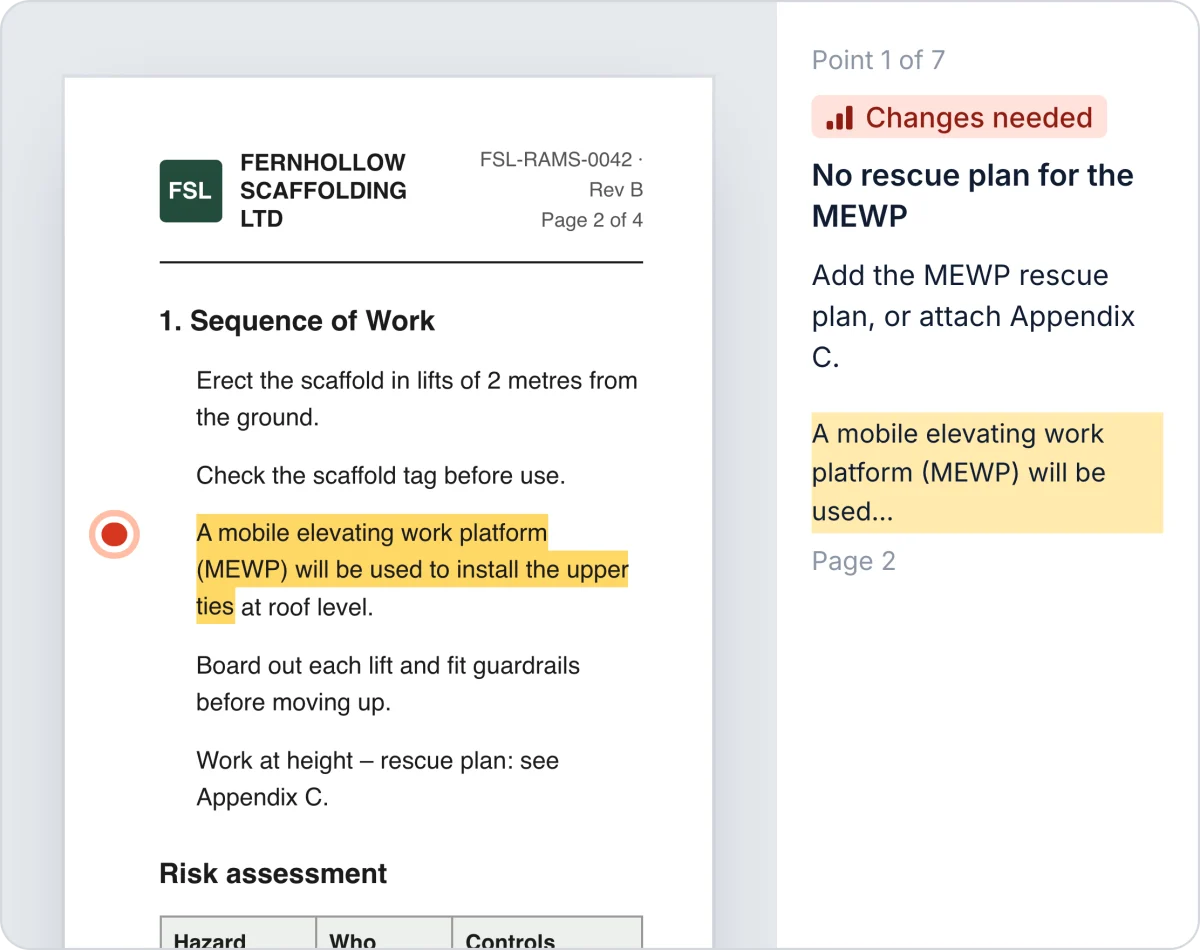
Landscaping RAMS template
A blank landscaping RAMS to fill in: job details, method statement, risk assessment and briefing record.
Risk assessment and method statement
Landscaping RAMS
- Company
- left blank to fill in
- Site and work area
- left blank to fill in
- Planned dates
- left blank to fill in
- In charge on site
- left blank to fill in
- Team
- left blank to fill in
Method statement
- 1
- 2
- 3
- 4
- 5
- 6
Risk assessment
| Hazard | Who might be harmed and how | Controls in place | Further action |
|---|---|---|---|
Landscaping RAMS example
The same RAMS, filled in for one job.
Risk assessment and method statement
Landscaping, 27 Orchard Close, Wilmslow: rear garden
Risk assessment
People entering the work area or tripping over materials
Workers, occupants and visitors
Mark or barrier the active work area. Store tools and materials away from access routes.
A spade, fork or machine hits a live cable, gas pipe or water main
Landscapers, workers nearby and the public
Use the agreed detector and safe digging method. Stop, keep clear and report anything unexpected.
A damaged unit fails during handling or leaves an unsafe finished surface
Landscapers and people using the area
Check the actual product instructions. Do not substitute a different laying method.
Wind catches the materials and equipment and blows them onto people nearby
The team and people nearby
Check the forecast before you start and agree when the wind stops the work. Tie down or take in loose materials before you leave.
Back and shoulder injury from carrying heavy or long items
Everyone handling materials
Use a trolley or sack truck on the flat where the load suits one.
A machine, thrown object or moving part injures a worker, child, pet or passer-by
Operators, workers, residents, pets and passers-by
Use guards and the operator instructions. Keep people out until the machine has stopped.
Petrol spilled near a hot engine catches fire
The person refuelling and people nearby
Never keep fuel in an unmarked bottle. Soak a spill up straight away and keep it out of drains.
Someone trips on an open edge or disturbs unfinished paving
Landscapers, residents and visitors
Provide an agreed alternative route. Check the area before removing the separation.
Paving moves or cannot carry the expected use
Landscapers, residents and visitors
Use the agreed design. Stop if the ground, loads or drainage design is not settled.
Broken units, spoil or bags cause trips, and slurry or cement blocks drains
Landscapers, residents, visitors and waste carriers
Keep spoil and rubble apart from packaging and from anything contaminated. Cover gullies near the cutting and mixing area and leave no waste where it can wash into a drain.
A strike on a service nobody found, a trip into the dig, or strain from moving spoil
Landscapers, residents and visitors
Barrow spoil on boards and keep loads small. Mark the edge of the dig and leave it closed off at the end of each day.
Wet concrete burns the skin, or an edging unit traps fingers
Landscapers
Keep wet concrete off skin and out of boots. Lower each unit into place, do not drop it.
Hearing damage and hand-arm vibration from power tools
The person on the compactor or cutter
Use sharp blades and discs, which cut faster with less vibration. Warn people nearby before you start cutting.
Noise and hand-arm vibration from the plate compactor, or the plate runs onto a foot
The person on the compactor
Walk behind the handle with feet clear of the plate. Stop the engine before moving it across the garden.
Wet or disturbed sand lets the blocks settle unevenly and leaves a trip edge
Landscapers and people using the area
Keep off the screeded sand. Work from the blocks already laid.
Knee and back strain from long spells kneeling and bending
Landscapers
Keep the packs close to the laying edge. Share the laying and barrowing so nobody kneels all day.
Silica dust from power cutting damages the lungs
The person cutting and anyone downwind
Cut in one place, downwind of the house and well away from anyone else. Keep people out until the cutting has stopped and the slurry is cleared. Collect any slurry while it is wet. Clear any dry dust with an H or M Class vacuum, not a brush.
Silica dust if the water stops, and slipping on slurry
The person cutting and anyone nearby
Stop cutting if the water stops.
A disc bursts or the tool kicks back and cuts the user
The person cutting
Only someone trained to change discs fits them. Stop and swap any cracked or worn disc.
Blocks move, or the plate runs onto a foot on the finished surface
Landscapers and people using the area
Keep people off until the joints are full. Wear ear defenders on the compactor.
Debris, tools or unfinished work left in the area
Workers, occupants and visitors
Remove waste by the agreed route. Record and protect any unfinished work.
Landscaping, 27 Orchard Close, Wilmslow: rear garden
- Company
- Hollins & Reed Landscapes Ltd
- Site and work area
- 27 Orchard Close, Wilmslow: rear garden
- Planned dates
- 12 to 14 October 2026
- In charge on site
- Dan Hollins
- Team
- Two landscapers: Dan Hollins leads and checks the garden each morning; Priya Shah works with him.
Method statement
- 1Set up the work areaConfirm the work area and scope before starting. Keep other people outside the active work area. Keep entrances and escape routes clear.
- 2Find buried services before diggingGet the service plans, scan and mark the ground before breaking it. Do not dig until an unsafe or unknown service has been dealt with.
- 3Check the paving deliveryInspect units for damage and confirm this job's product before installation. Hold damaged or unsuitable units out of the work.
- 4Check the weather before you startStop handling materials and equipment when the wind is strong enough to catch them. Stop in heavy rain, ice or lightning.
- 5Carry the blocks, sand and stone safelyPlan the route, clear it, and get help with anything long or heavy. Store materials close to the work so nobody carries further than they need to.
- 6Keep the cutter and compactor away from peopleSet a clear exclusion area before starting the disc cutter or plate compactor. Stop the machine when anyone enters the area.
- 7Look after the fuelKeep petrol and oil in their own labelled cans, away from drains and hot exhausts. Refuel with the engine off and cool, and keep a spill kit with you.
- 8Keep people off open pavingSeparate the work from people using the route. Keep unfinished edges and materials controlled until the surface is safe.
- 9Set the paving build-upBase the paving design on the ground conditions and expected loads. Do not guess the base, bedding or falls.
- 10Separate and remove the paving wasteKeep broken units, offcuts, spoil and packaging apart as you go. Keep cutting slurry, cement and sand out of gullies and drains; remove the waste before people return.
- 11Dig out to the depth of the build-upDig to the depth of the sub-base, sand and blocks together, and keep the finished level at least 150 mm below the damp proof course. Dig with an insulated spade or shovel near any marked service, working alongside it and never spiking the ground. Stop if you find a pipe, cable, marker tape or old footing the check did not show.
- 12Set the edge restraint firstSet the edging before any sub-base goes in, with a firm vertical face down past the sand. Wear waterproof gloves with wet concrete and wash any off your skin straight away.
- 13Limit noise and vibrationWear ear defenders on the compactor and when cutting. Note how long each person's hands are on each tool while it runs. Take the tool's vibration figure from the maker or HSE's table and check it fits how you use it. Points per hour times hours on the trigger, added up for the day, gives the exposure: 100 points is the action value, 400 is the limit. HSE's vibration calculator does the sum. Over 100, cut it with lower-vibration kit or less time, and never pass 400. Write the result down. Sharing the work does not replace this. Keep the tools maintained.
- 14Lay and compact the sub-baseSpread the sub-base in layers of no more than 75 mm and compact each one with the plate compactor before the next. Build the falls into the sub-base, not the sand. Wear ear defenders on the compactor and keep a note of each person's time on the handle for the vibration assessment.
- 15Screed the sand laying courseSpread the sand to an even depth, compact it, then screed it, 30 mm when compacted. Lay out only what you will cover in this working period, and leave no more than 1 m uncovered at the end of the day. Do not use the sand to level up. Cover any exposed sand overnight and in bad weather.
- 16Lay the blocks from the laid surfaceDraw blocks from at least three packs and lay the whole blocks first, working off the laid surface. Leave cut blocks to the edges and obstacles, and cut none smaller than a quarter of a block. Kneel on knee pads or a kneeling board, and stand up and change task through the day.
- 17Control the dust when cuttingSplit blocks with a block splitter where you can, and keep saw cuts to the ones it cannot do. Saw cuts: water or H or M Class extraction, plus an APF 20 mask (FFP3), fit tested and clean-shaven.
- 18Wet cuttingThis job is wet cutting: keep water on and collect the slurry.
- 19Use the disc cutter safelyCheck the disc is the right type and speed for the tool and the material. Keep the guard on and both hands on the tool. Wear impact-rated eye protection.
- 20Fill the joints and compact the blocksFit the rubber or neoprene sole plate to the compactor. Brush dry jointing sand into every joint before the final compaction. Run the plate compactor over the blocks, then top up the joints.
- 21Clear and hand back the areaRemove tools, waste and unused materials. Check the area is clean and ready to use. Tell the customer or whoever runs the site when the work is complete.
What a landscaping RAMS covers
Fencing, paving and kerbs, planting and turfing, mowing, strimming and garden maintenance. Not covered: stump grinding, tree felling and tree climbing.
- Fence/repair
- Mow/trim
- Lay paving/kerbs
- Ordinary garden maintenance
- Plant/lay turf
Suggested steps and hazards for landscaping
Suggested for lay paving/kerbs before any questions are answered.
Find buried services before digging
- Get the service plans, scan and mark the ground before breaking it.
- Do not dig until an unsafe or unknown service has been dealt with.
Hazard
A spade, fork or machine hits a live cable, gas pipe or water main
Who might be harmed and how
Landscapers, workers nearby and the public
Controls in place
- Use the agreed detector and safe digging method.
- Stop, keep clear and report anything unexpected.
Buried services are not visible and a small dig can cause shock, fire, flooding or an outage.
HSE: Gas safety for employers Check the paving delivery
- Inspect units for damage and confirm this job's product before installation.
- Hold damaged or unsuitable units out of the work.
Hazard
A damaged unit fails during handling or leaves an unsafe finished surface
Who might be harmed and how
Landscapers and people using the area
Controls in place
- Check the actual product instructions.
- Do not substitute a different laying method.
The right product and an undamaged delivery are part of a safe finished surface.
Marshalls concrete block paving installation guide Keep the cutter and compactor away from people
- Set a clear exclusion area before starting the disc cutter or plate compactor.
- Stop the machine when anyone enters the area.
Hazard
A machine, thrown object or moving part injures a worker, child, pet or passer-by
Who might be harmed and how
Operators, workers, residents, pets and passers-by
Controls in place
- Use guards and the operator instructions.
- Keep people out until the machine has stopped.
Machines and mowers can throw stones and cut or crush anyone who comes too close.
Impact hazards
What the builder asks about landscaping
Your answers decide which steps, hazards and controls it suggests.
The job
- What are you doing to the fence?
- What will you cut, and with what?
- What are you laying?
- What will you be doing in the garden?
- What are you putting in?
- What are the fence parts made of?
Where
- What is in the grass or around it?
- What might be in the beds and borders?
- Is the ground ready for planting or turf?
- Is the cutting ground firm and clear?
- What pipes or cables run under ground to be dug or through the work area?
How it’s done
- What will you stand on to reach the work?
- What laying system is specified?
- How will the panels, posts, paving and bags get to the work?
What your landscaping RAMS includes
Method statement
The work in order, step by step.
Risk assessment
Each hazard, who could be harmed, the controls in place and any further action.
The method statement and risk assessment in one A4 PDF. Your logo on Pro and Team.
What the law asks for
What a RAMS is
A risk assessment and method statement. The risk assessment records what could cause harm on the job, who could be harmed and how, and the controls that keep the risk down. The method statement sets out how the work will be done, step by step, in the order it happens.
A client or main contractor will usually ask for one before you start. RAMS is a site term, not a legal one: the law asks for the risk assessment and for the work to be planned, and a method statement is the usual way to show that plan for one job.
What the law asks for
- Employers, and self-employed people doing construction work, must make a suitable and sufficient assessment of the risks to their own people and to anyone else affected by the work (Management of Health and Safety at Work Regulations 1999, regulation 3).
- An employer with five or more employees must record the significant findings and any group of employees it finds especially at risk. The assessment must be reviewed if there is reason to think it is no longer valid, or the work has changed significantly.
- Every contractor must plan, manage and monitor its work so that, so far as is reasonably practicable, it is done without risks to health and safety, and must give its workers the information and instructions they need, including the hazards the risk assessment found (Construction (Design and Management) Regulations 2015, regulation 15).
HSE guidance: the steps to manage risk and what contractors must do under CDM. This is the law in Great Britain; Northern Ireland has its own equivalent regulations.
What the builder does
You choose the work and answer questions about how the job will be done, such as what you will stand on and what else is going on nearby. Your answers decide which steps, hazards and controls it suggests.
Many suggestions link to the HSE guidance they draw on. Your work is kept in this browser and, signed in, on your account with its photos; the PDF is made on your device. A briefing you send to phones goes through your account.
Separate documents
A COSHH assessment, lifting plan, permit to work, asbestos survey and the principal contractor’s construction phase plan are separate from the RAMS.
Reviewing a RAMS before work starts
RAMS review reads a RAMS PDF, yours before you send it or one a subcontractor sends you, and lists the points to raise, each marked on the page it comes from. Quick reviews are free.