
Temporary works RAMS Builder
Temporary works risk assessment and method statement
Checking this browser for your work…
RAMS review
Check a RAMS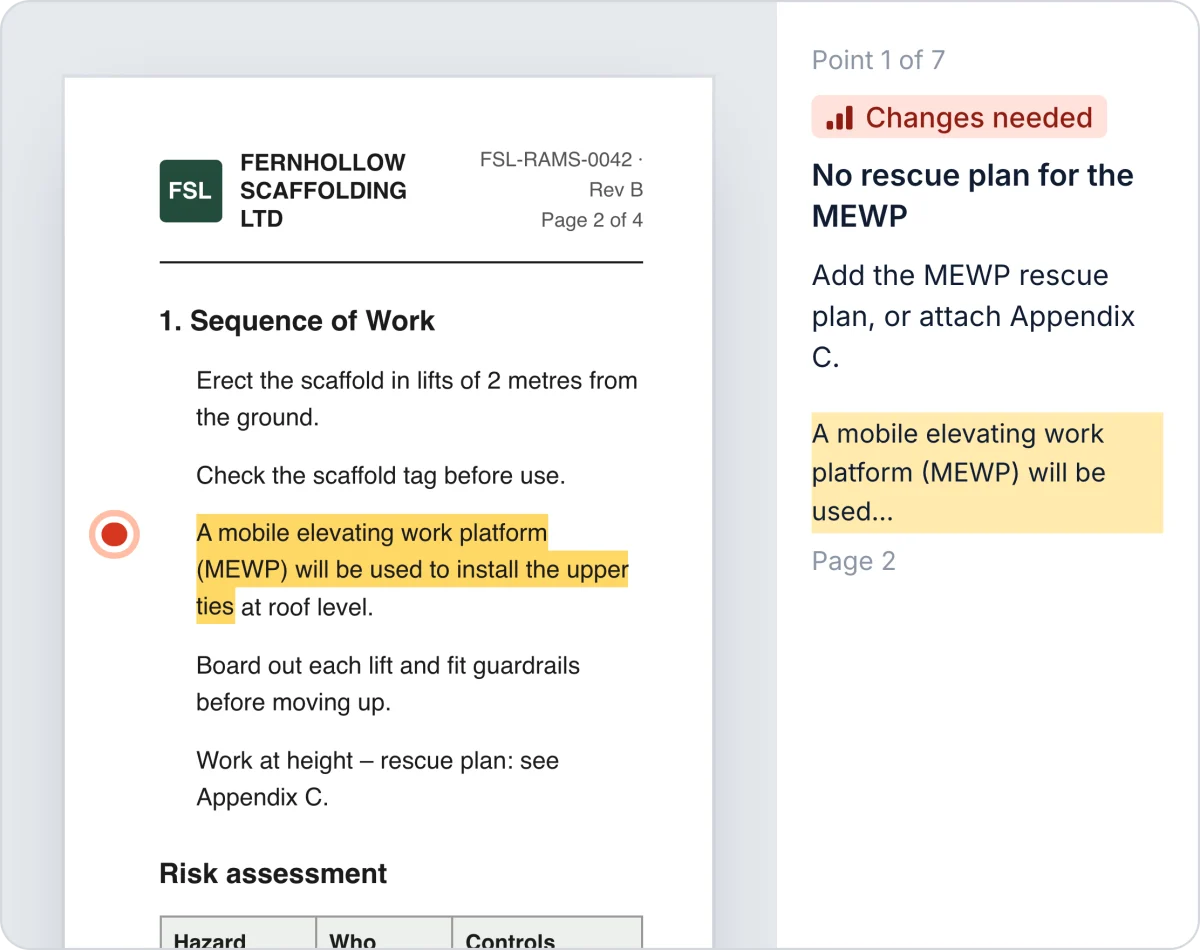
Temporary works RAMS template
A blank temporary works RAMS to fill in: job details, method statement, risk assessment and briefing record.
Risk assessment and method statement
Temporary works RAMS
- Company
- left blank to fill in
- Site and work area
- left blank to fill in
- Planned dates
- left blank to fill in
- In charge on site
- left blank to fill in
- Team
- left blank to fill in
Method statement
- 1
- 2
- 3
- 4
- 5
- 6
Risk assessment
| Hazard | Who might be harmed and how | Controls in place | Further action |
|---|---|---|---|
Temporary works RAMS example
The same RAMS, filled in for one job.
Risk assessment and method statement
Temporary works, Plot 4, Wharf Lane, Stockport: new build site frontage
Risk assessment
People entering the work area or tripping over materials
Workers, occupants and visitors
Mark or barrier the active work area. Store tools and materials away from access routes.
A delivery vehicle strikes a worker, visitor or member of the public
Workers, drivers, visitors and the public
Separate people and vehicles where possible. Use the agreed marshal and stop the movement if the route is blocked.
People enter the work area or are struck by work, materials or vehicles
Workers, visitors and the public
Set the boundary before installation. Explain access rules to authorised people.
A barrier or hoarding collapses, blows over or fails under a foreseeable load
Workers, visitors and the public
Stop if the site differs from the arrangement. Keep the current arrangement available to the installation team.
Wind catches the barrier panels and hoarding and blows them onto people nearby
The team and people nearby
Check the forecast before you start and agree when the wind stops the work. Tie down or take in loose materials before you leave.
Back and shoulder injury from carrying heavy or long items
Everyone handling materials
Use a trolley or sack truck on the flat where the load suits one. Where the work is up a level, hand items up or hoist them. Never carry them up a ladder.
People walk into the installation area or are forced into traffic
The public, visitors and installers
Use signs and a marshal where the route changes. Do not leave an open gap beside a live footway.
Part-built panels fall or leave an unprotected gap beside the work
Installers and people nearby
Follow the maker instructions or checked design. Use the planned fixing and ballast arrangement.
A damaged boundary moves, falls or leaves people exposed to the work
Workers, visitors and the public
Record checks and defects. Keep the boundary secure while repairs are made.
The boundary moves because its ballast or fixings do not hold it
Installers, workers and the public
Use only the ballast and fixings in the arrangement. Stop if the ground or building differs from the information.
Children or members of the public enter an unsecured work area after the shift
The public and people in nearby buildings
Check the whole perimeter before leaving. Keep materials inside the boundary and away from its edge.
Debris, tools or unfinished work left in the area
Workers, occupants and visitors
Remove waste by the agreed route. Record and protect any unfinished work.
Temporary works, Plot 4, Wharf Lane, Stockport: new build site frontage
- Company
- Hollins & Reed Site Services Ltd
- Site and work area
- Plot 4, Wharf Lane, Stockport: new build site frontage
- Planned dates
- 12 to 14 October 2026
- In charge on site
- Dan Hollins
- Team
- Two operatives: Dan Hollins leads and checks the area each morning; Priya Shah works with him.
Method statement
- 1Set up the work areaConfirm the work area and scope before starting. Keep other people outside the active work area. Keep entrances and escape routes clear.
- 2Plan deliveries and vehicle routesAgree the delivery point, vehicle route, unloading area and reversing controls before anything arrives. Keep pedestrians away from moving vehicles and keep the route clear.
- 3Plan the boundary and public routesSet the perimeter, gates, crossings and delivery access before installation. Keep people out of the work and give the public a safe route past it.
- 4Treat the boundary as temporary worksUse the manufacturer arrangement or a checked design for the ground, exposure and expected loads. Do not invent ballast, fixings or a support detail.
- 5Check the weather before you startStop handling barrier panels and hoarding when the wind is strong enough to catch them. Stop in heavy rain, ice or lightning.
- 6Carry the barrier panels and hoarding safelyPlan the route, clear it, and get help with anything long or heavy. Store materials close to the work so nobody carries further than they need to.
- 7Keep the public route clearKeep gates, footways and crossings clear while panels or barriers go up. Use a safe route past the work where the normal path changes.
- 8Install it to the arrangementBuild the boundary in the stated order and secure each section before moving on. Keep people out of the installation area until the section is stable.
- 9Inspect and maintain the boundaryCheck panels, feet, ballast, anchors, gates and gaps after installation and bad weather. Repair or replace damaged sections before people pass beside them.
- 10Use the planned holding methodSet feet, blocks, anchors or building fixings out as the arrangement shows. Check the ground or building can take the holding method.
- 11Secure the boundary before leavingSecure gates and close gaps before the shift ends. Keep the boundary protecting people until the site is handed back.
- 12Clear and hand back the areaRemove tools, waste and unused materials. Check the area is clean and ready to use. Tell the customer or whoever runs the site when the work is complete.
What a temporary works RAMS covers
Putting up hoarding and barriers to a checked arrangement, and setting up the compound and welfare. Not covered: propping and formwork.
- Barrier/hoard
- Establish site/welfare
Suggested steps and hazards for temporary works
Suggested for barrier/hoard before any questions are answered.
Plan deliveries and vehicle routes
- Agree the delivery point, vehicle route, unloading area and reversing controls before anything arrives.
- Keep pedestrians away from moving vehicles and keep the route clear.
Hazard
A delivery vehicle strikes a worker, visitor or member of the public.
Who might be harmed and how
Workers, drivers, visitors and the public
Controls in place
- Separate people and vehicles where possible.
- Use the agreed marshal and stop the movement if the route is blocked.
A planned route prevents vehicle movements becoming an uncontrolled site hazard.
Protecting the public - HSE Plan the boundary and public routes
- Set the perimeter, gates, crossings and delivery access before installation.
- Keep people out of the work and give the public a safe route past it.
Hazard
People enter the work area or are struck by work, materials or vehicles.
Who might be harmed and how
Workers, visitors and the public
Controls in place
- Set the boundary before installation.
- Explain access rules to authorised people.
A planned boundary controls access and protects people beside the work.
Protecting the public - HSE Treat the boundary as temporary works
- Use the manufacturer arrangement or a checked design for the ground, exposure and expected loads.
- Do not invent ballast, fixings or a support detail.
Hazard
A barrier or hoarding collapses, blows over or fails under a foreseeable load.
Who might be harmed and how
Workers, visitors and the public
Controls in place
- Stop if the site differs from the arrangement.
- Keep the current arrangement available to the installation team.
Hoarding and barriers are temporary works and must suit the loads they may face.
HSE: Temporary Works
What the builder asks about temporary works
Your answers decide which steps, hazards and controls it suggests.
The job
- Are you setting up, moving the compound or handing the site back?
- What are you putting up?
Where
- How will deliveries and vehicles use the site?
- What pipes or cables run in the ground or building you will fix or disturb?
How it’s done
- What will you stand on to reach the work?
- What will people use for toilets, washing and breaks?
- What shows it will stand up in the wind?
- How will it be held down or fixed?
- What are you putting in or connecting?
- How will the barrier panels and hoarding get to the work?
What you’ve been told
- What first-aid cover is arranged?
What your temporary works RAMS includes
Method statement
The work in order, step by step.
Risk assessment
Each hazard, who could be harmed, the controls in place and any further action.
The method statement and risk assessment in one A4 PDF. Your logo on Pro and Team.
What the law asks for
What a RAMS is
A risk assessment and method statement. The risk assessment records what could cause harm on the job, who could be harmed and how, and the controls that keep the risk down. The method statement sets out how the work will be done, step by step, in the order it happens.
A client or main contractor will usually ask for one before you start. RAMS is a site term, not a legal one: the law asks for the risk assessment and for the work to be planned, and a method statement is the usual way to show that plan for one job.
What the law asks for
- Employers, and self-employed people doing construction work, must make a suitable and sufficient assessment of the risks to their own people and to anyone else affected by the work (Management of Health and Safety at Work Regulations 1999, regulation 3).
- An employer with five or more employees must record the significant findings and any group of employees it finds especially at risk. The assessment must be reviewed if there is reason to think it is no longer valid, or the work has changed significantly.
- Every contractor must plan, manage and monitor its work so that, so far as is reasonably practicable, it is done without risks to health and safety, and must give its workers the information and instructions they need, including the hazards the risk assessment found (Construction (Design and Management) Regulations 2015, regulation 15).
HSE guidance: the steps to manage risk and what contractors must do under CDM. This is the law in Great Britain; Northern Ireland has its own equivalent regulations.
What the builder does
You choose the work and answer questions about how the job will be done, such as what you will stand on and what else is going on nearby. Your answers decide which steps, hazards and controls it suggests.
Many suggestions link to the HSE guidance they draw on. Your work is kept in this browser and, signed in, on your account with its photos; the PDF is made on your device. A briefing you send to phones goes through your account.
Separate documents
A COSHH assessment, lifting plan, permit to work, asbestos survey and the principal contractor’s construction phase plan are separate from the RAMS.
Reviewing a RAMS before work starts
RAMS review reads a RAMS PDF, yours before you send it or one a subcontractor sends you, and lists the points to raise, each marked on the page it comes from. Quick reviews are free.