
Grinding RAMS Builder
Grinding risk assessment and method statement
Checking this browser for your work…
RAMS review
Check a RAMS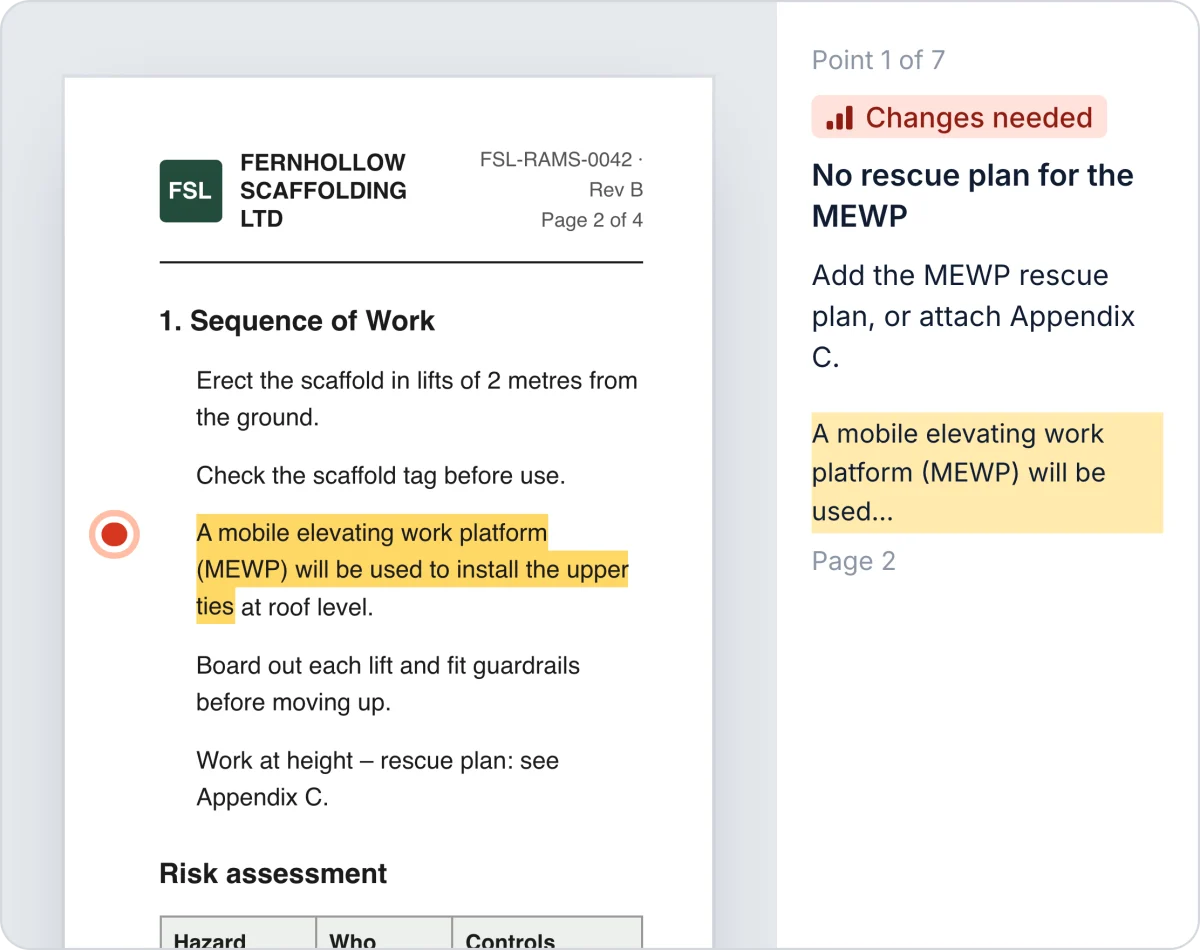
Grinding RAMS template
A blank grinding RAMS to fill in: job details, method statement, risk assessment and briefing record.
Risk assessment and method statement
Grinding RAMS
- Company
- left blank to fill in
- Site and work area
- left blank to fill in
- Planned dates
- left blank to fill in
- In charge on site
- left blank to fill in
- Team
- left blank to fill in
Method statement
- 1
- 2
- 3
- 4
- 5
- 6
Risk assessment
| Hazard | Who might be harmed and how | Controls in place | Further action |
|---|---|---|---|
Grinding RAMS example
The same RAMS, filled in for one job.
Risk assessment and method statement
Grinding, Plant room, Kingsway Retail Park, Stockport
Risk assessment
People entering the work area or tripping over materials
Workers, occupants and visitors
Mark or barrier the active work area. Store tools and materials away from access routes.
A wrong or badly mounted wheel breaks and throws fragments
The operator and anyone nearby
Use the wheel only for the work it is designed to do. Have a trained person change damaged or worn wheels.
Hitting a live cable or gas pipe causes shock, fire or gas escape
The person doing the work and everyone nearby
Check again wherever the work moves. If you hit something, stop, keep clear and report it.
Back and shoulder injury from carrying heavy or long items
Everyone handling materials
Use a trolley or sack truck on the flat where the load suits one. Where the work is up a level, hand items up or hoist them. Never carry them up a ladder.
Cutting into a live cable or conduit gives a shock, a flash burn or starts a fire
The person cutting and anyone nearby
Only the person who locked it off takes the lock off. Prove the tester on a known live source before and after.
Sparks, hot metal or slag starts a fire
Everyone in and near the work area
Sparks can travel a long way and start fires in other rooms: check the routes they can take. Put a cold method first if the job can be done without heat.
Hand-arm vibration from the grinder
The person grinding
Keep the tools maintained and hands warm. Gloves do not stop vibration. Give health checks to anyone above the action value.
Kickback, trapped fingers or an offcut dropping as it comes free
The operator and anyone below or nearby
Keep both hands on the tool where its design allows. Stop if the part is loaded or the support is not clear.
Fragments, sparks or hot swarf injure someone nearby
The operator and everyone near the work
Wear hearing protection and a face shield for grinding. Stop if sparks reach anything that was not cleared.
Hot work starts before the fire precautions are in place
Everyone in and near the work area
No permit, no hot work. A new shift or a new place needs a new permit.
A fire takes hold unseen during the work or a break
Everyone in and near the work area
The fire watcher raises the alarm first, and tackles a fire only if it is safe. Stop and get the permit changed if the job or the place changes.
A smouldering fire develops after the work stops
Everyone in and near the work area
Tell the site when the work and watch are finished. Keep to a longer watch if the site requires one.
Debris, tools or unfinished work left in the area
Workers, occupants and visitors
Remove waste by the agreed route. Record and protect any unfinished work.
Grinding, Plant room, Kingsway Retail Park, Stockport
- Company
- Hollins & Reed Metalwork Ltd
- Site and work area
- Plant room, Kingsway Retail Park, Stockport
- Planned dates
- 12 to 14 October 2026
- In charge on site
- Dan Hollins
- Team
- Two operatives: Dan Hollins grinds; Priya Shah is the fire watch and clears the cuttings.
Method statement
- 1Set up the work areaConfirm the work area and scope before starting. Keep other people outside the active work area. Keep entrances and escape routes clear.
- 2Check the wheel and guardCheck the wheel type, speed and mounting before use. Fit the guard and side handle; stop if the guard cannot stay between you and the wheel.
- 3Find and isolate hidden servicesFind cables and pipes before you disturb anything: drawings, then a detector. Mark what you find. Not sure what is there? Turn the supply off, or do not start. Have cables and gas isolated by the right person and prove them dead before you start.
- 4Carry the steel, tools and metal parts safelyPlan the route, clear it, and get help with anything long or heavy. Store materials close to the work so nobody carries further than they need to.
- 5Prove it dead before you cut into itMetalwork often carries cables, conduit or trunking. Get the circuit switched off, locked off and proved dead first. Do not cut, grind or weld on anything still live.
- 6Clear combustibles before hot workWalk the area with the site contact. Check around the work, below it and on the other side of any partition. Move combustible material away, or cover it with flame-resistant covers. Protect openings with non-combustible board. Agree which detector zone is isolated, who isolates it and who puts it back on. Place at least two suitable extinguishers at the work and post a fire watcher who is not doing the hot work.
- 7Assess vibration from the grinderNote how long each person's hands are on each tool while it runs. Take the tool's vibration figure from the maker or HSE's table and check it fits how you use it. Points per hour times hours on the trigger, added up for the day, gives the exposure: 100 points is the action value, 400 is the limit. HSE's vibration calculator does the sum. Over 100, cut it with lower-vibration kit or less time, and never pass 400. Write the result down. Sharing the work does not replace this.
- 8Set up the cut safelyClamp the piece so it cannot twist or close on the blade. Support the offcut before the final part of the cut.
- 9Protect eyes and control sparksWear suitable eye protection and keep people out of the spark and fragment line. Keep the sparks inside the cleared area.
- 10Get the hot-work permit for this place and shiftGet a permit for this location and this shift, once the area is cleared and the fire cover is in place. It states the place, the times, the precautions, how to raise the alarm, who is in control and who authorised it. Keep a copy on display at the work.
- 11Work under the permitDo only the cutting, grinding, welding or heating the permit covers. Grinding sparks are hot work too. Keep the fire watcher on duty during the work and through every break. Stop hot work two hours before the end of the working day.
- 12Complete the fire watch before handbackKeep a continuous fire watch for at least an hour after hot work stops, then make at least one more check two hours after finishing. Inspect behind walls, below floors and in voids before closing the permit. Have the detector zone put back on as soon as the work stops, and sign off the permit.
- 13Clear and hand back the areaRemove tools, waste and unused materials. Check the area is clean and ready to use. Tell the customer or whoever runs the site when the work is complete.
What a grinding RAMS covers
Dressing, cutting and finishing metal with an angle grinder, cut-off disc or saw. Not covered: grinding concrete or stone.
Suggested steps and hazards for grinding
Suggested for grind/cold cut before any questions are answered.
Prove it dead before you cut into it
- Metalwork often carries cables, conduit or trunking. Get the circuit switched off, locked off and proved dead first.
- Do not cut, grind or weld on anything still live.
Hazard
Cutting into a live cable or conduit gives a shock, a flash burn or starts a fire
Who might be harmed and how
The person cutting and anyone nearby
Controls in place
- Only the person who locked it off takes the lock off.
- Prove the tester on a known live source before and after.
A lock-off and a proved dead test is the only way you know the circuit is off.
HSE: Electricity, systems in buildings Clear combustibles before hot work
- Walk the area with the site contact. Check around the work, below it and on the other side of any partition.
- Move combustible material away, or cover it with flame-resistant covers. Protect openings with non-combustible board.
- Agree which detector zone is isolated, who isolates it and who puts it back on.
- Place at least two suitable extinguishers at the work and post a fire watcher who is not doing the hot work.
Hazard
Sparks, hot metal or slag starts a fire
Who might be harmed and how
Everyone in and near the work area
Controls in place
- Sparks can travel a long way and start fires in other rooms: check the routes they can take.
- Put a cold method first if the job can be done without heat.
Removing or protecting combustibles controls fire from sparks, hot metal and slag.
HSE: Safety risks from welding Assess vibration from the grinder
- Note how long each person's hands are on each tool while it runs. Take the tool's vibration figure from the maker or HSE's table and check it fits how you use it. Points per hour times hours on the trigger, added up for the day, gives the exposure: 100 points is the action value, 400 is the limit. HSE's vibration calculator does the sum. Over 100, cut it with lower-vibration kit or less time, and never pass 400. Write the result down. Sharing the work does not replace this.
Hazard
Hand-arm vibration from the grinder
Who might be harmed and how
The person grinding
Controls in place
- Keep the tools maintained and hands warm. Gloves do not stop vibration.
- Give health checks to anyone above the action value.
Time on the tool decides the harm, so it has to be measured against the tool that is actually used.
Construction physical ill health risks: Vibration Set up the cut safely
- Clamp the piece so it cannot twist or close on the blade.
- Support the offcut before the final part of the cut.
Hazard
Kickback, trapped fingers or an offcut dropping as it comes free
Who might be harmed and how
The operator and anyone below or nearby
Controls in place
- Keep both hands on the tool where its design allows.
- Stop if the part is loaded or the support is not clear.
The work and offcut must stay stable while the cut is made.
HSE: PUWER overview
What the builder asks about grinding
Your answers decide which steps, hazards and controls it suggests.
The job
- What will you cut or grind with?
- What is on the metal?
Where
- Is the building older than the year 2000? Older buildings can have asbestos in them.
- What pipes or cables run in, behind or through the metalwork you are cutting?
How it’s done
- What will you stand on to reach the work?
- Is any of it inside a tank, pit, chamber or duct?
- What is the piece doing when you cut it?
- How will the steel, tools and metal parts get to the work?
What your grinding RAMS includes
Method statement
The work in order, step by step.
Risk assessment
Each hazard, who could be harmed, the controls in place and any further action.
The method statement and risk assessment in one A4 PDF. Your logo on Pro and Team.
What the law asks for
What a RAMS is
A risk assessment and method statement. The risk assessment records what could cause harm on the job, who could be harmed and how, and the controls that keep the risk down. The method statement sets out how the work will be done, step by step, in the order it happens.
A client or main contractor will usually ask for one before you start. RAMS is a site term, not a legal one: the law asks for the risk assessment and for the work to be planned, and a method statement is the usual way to show that plan for one job.
What the law asks for
- Employers, and self-employed people doing construction work, must make a suitable and sufficient assessment of the risks to their own people and to anyone else affected by the work (Management of Health and Safety at Work Regulations 1999, regulation 3).
- An employer with five or more employees must record the significant findings and any group of employees it finds especially at risk. The assessment must be reviewed if there is reason to think it is no longer valid, or the work has changed significantly.
- Every contractor must plan, manage and monitor its work so that, so far as is reasonably practicable, it is done without risks to health and safety, and must give its workers the information and instructions they need, including the hazards the risk assessment found (Construction (Design and Management) Regulations 2015, regulation 15).
HSE guidance: the steps to manage risk and what contractors must do under CDM. This is the law in Great Britain; Northern Ireland has its own equivalent regulations.
What the builder does
You choose the work and answer questions about how the job will be done, such as what you will stand on and what else is going on nearby. Your answers decide which steps, hazards and controls it suggests.
Many suggestions link to the HSE guidance they draw on. Your work is kept in this browser and, signed in, on your account with its photos; the PDF is made on your device. A briefing you send to phones goes through your account.
Separate documents
A COSHH assessment, lifting plan, permit to work, asbestos survey and the principal contractor’s construction phase plan are separate from the RAMS.
Reviewing a RAMS before work starts
RAMS review reads a RAMS PDF, yours before you send it or one a subcontractor sends you, and lists the points to raise, each marked on the page it comes from. Quick reviews are free.