
Demolition RAMS Builder
Demolition risk assessment and method statement
Checking this browser for your work…
RAMS review
Check a RAMS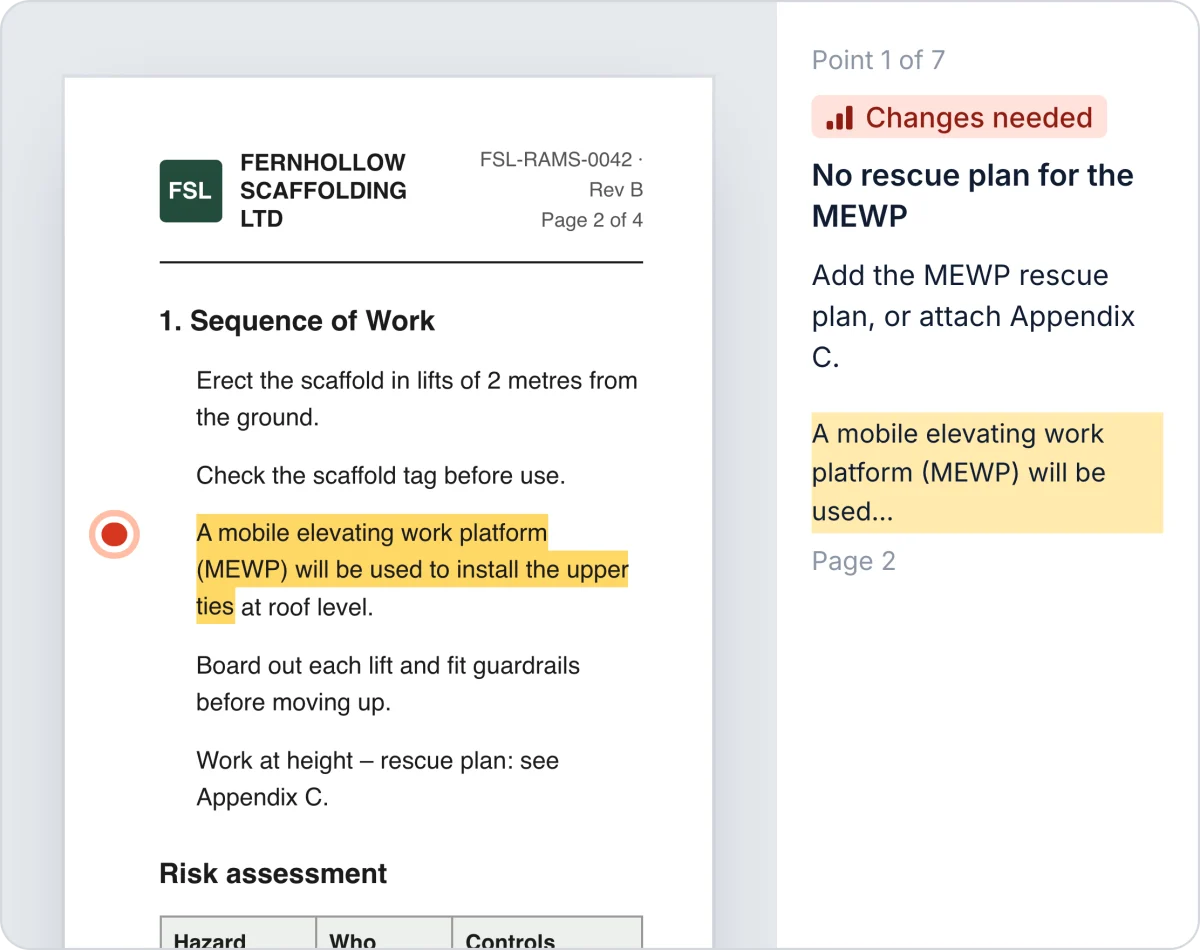
Demolition RAMS template
A blank demolition RAMS to fill in: job details, method statement, risk assessment and briefing record.
Risk assessment and method statement
Demolition RAMS
- Company
- left blank to fill in
- Site and work area
- left blank to fill in
- Planned dates
- left blank to fill in
- In charge on site
- left blank to fill in
- Team
- left blank to fill in
Method statement
- 1
- 2
- 3
- 4
- 5
- 6
Risk assessment
| Hazard | Who might be harmed and how | Controls in place | Further action |
|---|---|---|---|
Demolition RAMS example
The same RAMS, filled in for one job.
Risk assessment and method statement
Demolition, Rear garden, 9 Orchard Road, Stockport: detached garage
Risk assessment
People entering the work area or tripping over materials
Workers, occupants and visitors
Mark or barrier the active work area. Store tools and materials away from access routes.
Work starts without a written method, so nobody knows what is holding the structure up
The whole gang and anyone near the site
Work to the written order; if the building is not what the plan says, stop and get it looked at again. Keep the plan on site where the gang can read it.
Breathing asbestos fibres released by breaking up boards, sheets, lagging or floor tiles
The gang, other trades and anyone downwind
No refurbishment or demolition survey: do not break anything open. Licensed asbestos work is a separate job by a licensed contractor before you start.
Breaking into a live cable, gas pipe or water main causes shock, fire, flooding or explosion
The gang, the neighbours and anyone on the supply
A supply that has not been proved dead is treated as live. Keep the disconnection paperwork on site with the plan.
Someone works to yesterday's plan and walks into today's drop zone
The gang and anyone visiting the site
One person is in charge of the take-down and everybody knows who it is. Anyone new gets the brief before they set foot past the barrier.
Wind catches the sheets and loose material or blows someone off balance at height
The team and people below
Agree a wind limit for this work and check the forecast before you start. Tie down or take in loose materials before you leave.
Materials falling onto people below
People below
Bring waste down by hand, in bags or by the chute. Never throw it. Keep the exclusion zone up until the last item is down.
Falling from the tower platform; the tower overturning; tools or materials dropped from the platform
The person on the platform, where a guardrail or toe board is missing or was never fitted. Anyone on or beside the tower, if it is moved with people or materials on it, or built without its stabilisers. Anyone passing or working underneath.
Fit the required guardrails, braces and stabilisers. Move the tower only with nobody and nothing on it. Keep the area around the tower controlled.
Someone is inside the area where the structure or its debris can land
The gang, other trades, neighbours and the public
Nobody inside the exclusion zone while the work is going on. No room for the debris to land inside the site: stop and get the method changed.
Silica, plaster, wood and old dust from breaking up a building damage the lungs for life
Everyone breaking out and anyone downwind
Damp down before and while you break, not after. Clear up with a vacuum or wet sweep, never a dry brush.
Silica and board dust from power cutting damage the lungs
The person cutting and anyone downwind
Use the kit that fits the tool. Cut in one place, away from other trades. Collect any slurry while it is wet. Clear any dry dust with an H or M Class vacuum, not a brush.
Silica dust if the water stops, and slipping on slurry
The person cutting and anyone nearby
Stop cutting if the water stops.
Hearing damage and hand-arm vibration from power tools
The person cutting
Use sharp blades and discs, which cut faster with less vibration. Warn people nearby before you start cutting.
Removing the wrong element first brings the rest down without warning
The gang and anyone near the structure
If the structure moves, cracks or sounds different, everybody out and get the engineer. Changed fabric partway up: stop, the method may need changing too.
A wall or section collapses onto the person taking it down, or onto the platform they are on
The person on the tools and anyone below
Stop and get the engineer if the wall moves, bulges or is thinner than expected. A standard scaffold does not hold a building up; it is access only.
Trips, hidden nails and spikes, and waste that turns out to be hazardous
The gang, the plant operators and the waste crew
Flatten or knock over protruding nails and bend back sharp metal as you go. Never throw waste from height; drop it into a chute or lower it.
Debris, tools or unfinished work left in the area
Workers, occupants and visitors
Remove waste by the agreed route. Record and protect any unfinished work.
Demolition, Rear garden, 9 Orchard Road, Stockport: detached garage
- Company
- Hollins & Reed Demolition Ltd
- Site and work area
- Rear garden, 9 Orchard Road, Stockport: detached garage
- Planned dates
- 12 to 14 October 2026
- In charge on site
- Dan Hollins
- Team
- Three operatives: Dan Hollins leads and supervises the take-down sequence; Priya Shah and Sam Okafor work with him.
Method statement
- 1Set up the work areaConfirm the work area and scope before starting. Keep other people outside the active work area. Keep entrances and escape routes clear.
- 2Get the demolition plan before anything movesA competent person must write the demolition method down before work starts, for this structure and this site. Read the take-down order in it: what comes out first, what holds the rest up, and where it changes. Building control must have been given notice at least 6 weeks before demolition starts.
- 3Get the demolition asbestos survey firstAsk for the refurbishment or demolition survey, not the normal register; it is the client's job to give it to you. Asbestos must be taken out as far as is reasonably practicable before major refurbishment or demolition. Anything you find that is not in the survey: stop, keep people out and get it checked.
- 4Get the services cut off and proved deadGet gas, electric, water, drainage and telecoms cut off at the main by the supplier, and get it in writing. Ask for the drawings of anything live below ground in the work area before you dig or track a machine over it. Scan and mark what the drawings show, then prove it dead on the day before you break into it.
- 5Brief the gang every morningSay what comes down today, in what order, where the exclusion zone is and who is in charge of it. Agree the word or signal that stops everything, and make sure everyone can hear it over the plant. Nobody works on their own inside the demolition area.
- 6Check the weather before you startDo not lift or fix sheets and loose material in strong wind. Stop in heavy rain, ice or lightning.
- 7Stop things falling on people belowKeep people out of the area below the work so nobody walks under the materials. Keep toe boards and guards in place on any platform, and lanyard tools where you can.
- 8Use the mobile towerFollow the supplier instructions for any build or change. Check the tower before first use and after it is moved. Lock the wheels before using the platform. Climb using the internal access provided. Keep the toe boards on and tools and materials inside the guardrails.
- 9Set the exclusion zone and keep debris in itMark the safe working zone, the exclusion zone and the debris zone on the ground with barriers or hoarding. The size comes from the method, the space around the structure and how far debris can fall; the plan says what it is. If it collapses, deliberately or not, the debris must stay inside that zone and must not breach the site boundary. The zone changes as the work changes, so move the barriers with it.
- 10Keep the dust downUse water suppression or on-tool extraction on every task where it is possible. Wear RPE with an assigned protection factor of 20, such as an FFP3 mask or a half mask with a P3 filter. Tight-fitting masks need a face-fit test and a clean-shaven face; for over an hour at a time consider powered RPE. Open up the work area for natural ventilation, and keep other people out of the dust.
- 11Control the dust when cuttingNever cut dry in the open. Wear an APF 20 mask (FFP3 or P3) when you cut: fit tested and clean-shaven. Keep other people out of the dust.
- 12Wet cuttingThis job is wet cutting: keep water on and collect the slurry.
- 13Limit noise and vibrationWear ear defenders when cutting. Note how long each person's hands are on each tool while it runs. Take the tool's vibration figure from the maker or HSE's table and check it fits how you use it. Points per hour times hours on the trigger, added up for the day, gives the exposure: 100 points is the action value, 400 is the limit. HSE's vibration calculator does the sum. Over 100, cut it with lower-vibration kit or less time, and never pass 400. Write the result down. Sharing the work does not replace this. Keep the tools maintained.
- 14Take it down in the right orderTake out what is holding nothing up first, then work towards the stiff parts like braced cores and lift shafts. Watch for arches, overhangs, cantilevers and hanging floors; they go in the order the engineer set, not when it suits. Do not let debris pile up on a floor that is still standing. Never leave a free-standing wall or a part-demolished section standing at the end of the shift.
- 15Taking a wall down by handWork from the top down, course by course, so what is left is always lower than what has gone. Never stand or work off the thing you are taking down; work from a scaffold, tower or platform beside it. Do not undercut, and do not pull a wall over onto the ground by hand. Drop material inside the building or into the marked zone, never over the boundary.
- 16Handle the waste as you goKeep the site clear as you work; do not let waste build up where people walk or on a floor that is still standing. Keep anything suspect, such as insulation or lagging, separate and bagged until it has been checked. Load out with a licensed carrier and keep the waste transfer notes.
- 17Clear and hand back the areaRemove tools, waste and unused materials. Check the area is clean and ready to use. Tell the customer or whoever runs the site when the work is complete.
What a demolition RAMS covers
Soft strip, then taking down all or part of a structure by hand or machine to a written demolition plan. Not covered: removing asbestos before demolition.
- Soft strip
- Hand demolition
- Machine demolition
Suggested steps and hazards for demolition
Suggested for hand demolition before any questions are answered.
Get the demolition plan before anything moves
- A competent person must write the demolition method down before work starts, for this structure and this site.
- Read the take-down order in it: what comes out first, what holds the rest up, and where it changes.
- Building control must have been given notice at least 6 weeks before demolition starts.
Hazard
Work starts without a written method, so nobody knows what is holding the structure up
Who might be harmed and how
The whole gang and anyone near the site
Controls in place
- Work to the written order; if the building is not what the plan says, stop and get it looked at again.
- Keep the plan on site where the gang can read it.
Unplanned collapse is what kills demolition workers, and the written order is the thing that prevents it.
HSE: Structural stability during alteration, demolition and dismantling Get the demolition asbestos survey first
- Ask for the refurbishment or demolition survey, not the normal register; it is the client's job to give it to you.
- Asbestos must be taken out as far as is reasonably practicable before major refurbishment or demolition.
- Anything you find that is not in the survey: stop, keep people out and get it checked.
Hazard
Breathing asbestos fibres released by breaking up boards, sheets, lagging or floor tiles
Who might be harmed and how
The gang, other trades and anyone downwind
Controls in place
- No refurbishment or demolition survey: do not break anything open.
- Licensed asbestos work is a separate job by a licensed contractor before you start.
A demolition survey goes into the structure and finds the asbestos a normal survey never looks for.
The duty to manage asbestos in buildings: Arrange an asbestos survey - HSE Get the services cut off and proved dead
- Get gas, electric, water, drainage and telecoms cut off at the main by the supplier, and get it in writing.
- Ask for the drawings of anything live below ground in the work area before you dig or track a machine over it.
- Scan and mark what the drawings show, then prove it dead on the day before you break into it.
Hazard
Breaking into a live cable, gas pipe or water main causes shock, fire, flooding or explosion
Who might be harmed and how
The gang, the neighbours and anyone on the supply
Controls in place
- A supply that has not been proved dead is treated as live.
- Keep the disconnection paperwork on site with the plan.
Live services left in a building being pulled down are one of the classic demolition killers.
HSE: Electricity, systems in buildings
What the builder asks about demolition
Your answers decide which steps, hazards and controls it suggests.
The job
- What have you been given for this job?
- What are you taking down?
- What is coming out in the strip?
Where
- What does it touch or lean on?
- What pipes or cables run in, under or into the part coming down?
How it’s done
- What will you stand on to reach the work?
- What machine is doing the demolition?
- Will you cut anything on site, and with what?
What your demolition RAMS includes
Method statement
The work in order, step by step.
Risk assessment
Each hazard, who could be harmed, the controls in place and any further action.
The method statement and risk assessment in one A4 PDF. Your logo on Pro and Team.
What the law asks for
What a RAMS is
A risk assessment and method statement. The risk assessment records what could cause harm on the job, who could be harmed and how, and the controls that keep the risk down. The method statement sets out how the work will be done, step by step, in the order it happens.
A client or main contractor will usually ask for one before you start. RAMS is a site term, not a legal one: the law asks for the risk assessment and for the work to be planned, and a method statement is the usual way to show that plan for one job.
What the law asks for
- Employers, and self-employed people doing construction work, must make a suitable and sufficient assessment of the risks to their own people and to anyone else affected by the work (Management of Health and Safety at Work Regulations 1999, regulation 3).
- An employer with five or more employees must record the significant findings and any group of employees it finds especially at risk. The assessment must be reviewed if there is reason to think it is no longer valid, or the work has changed significantly.
- Every contractor must plan, manage and monitor its work so that, so far as is reasonably practicable, it is done without risks to health and safety, and must give its workers the information and instructions they need, including the hazards the risk assessment found (Construction (Design and Management) Regulations 2015, regulation 15).
HSE guidance: the steps to manage risk and what contractors must do under CDM. This is the law in Great Britain; Northern Ireland has its own equivalent regulations.
What the builder does
You choose the work and answer questions about how the job will be done, such as what you will stand on and what else is going on nearby. Your answers decide which steps, hazards and controls it suggests.
Many suggestions link to the HSE guidance they draw on. Your work is kept in this browser and, signed in, on your account with its photos; the PDF is made on your device. A briefing you send to phones goes through your account.
Separate documents
A COSHH assessment, lifting plan, permit to work, asbestos survey and the principal contractor’s construction phase plan are separate from the RAMS.
Reviewing a RAMS before work starts
RAMS review reads a RAMS PDF, yours before you send it or one a subcontractor sends you, and lists the points to raise, each marked on the page it comes from. Quick reviews are free.