
Ductwork access panel installation RAMS Builder
Ductwork access panel installation risk assessment and method statement
Checking this browser for your work…
RAMS review
Check a RAMS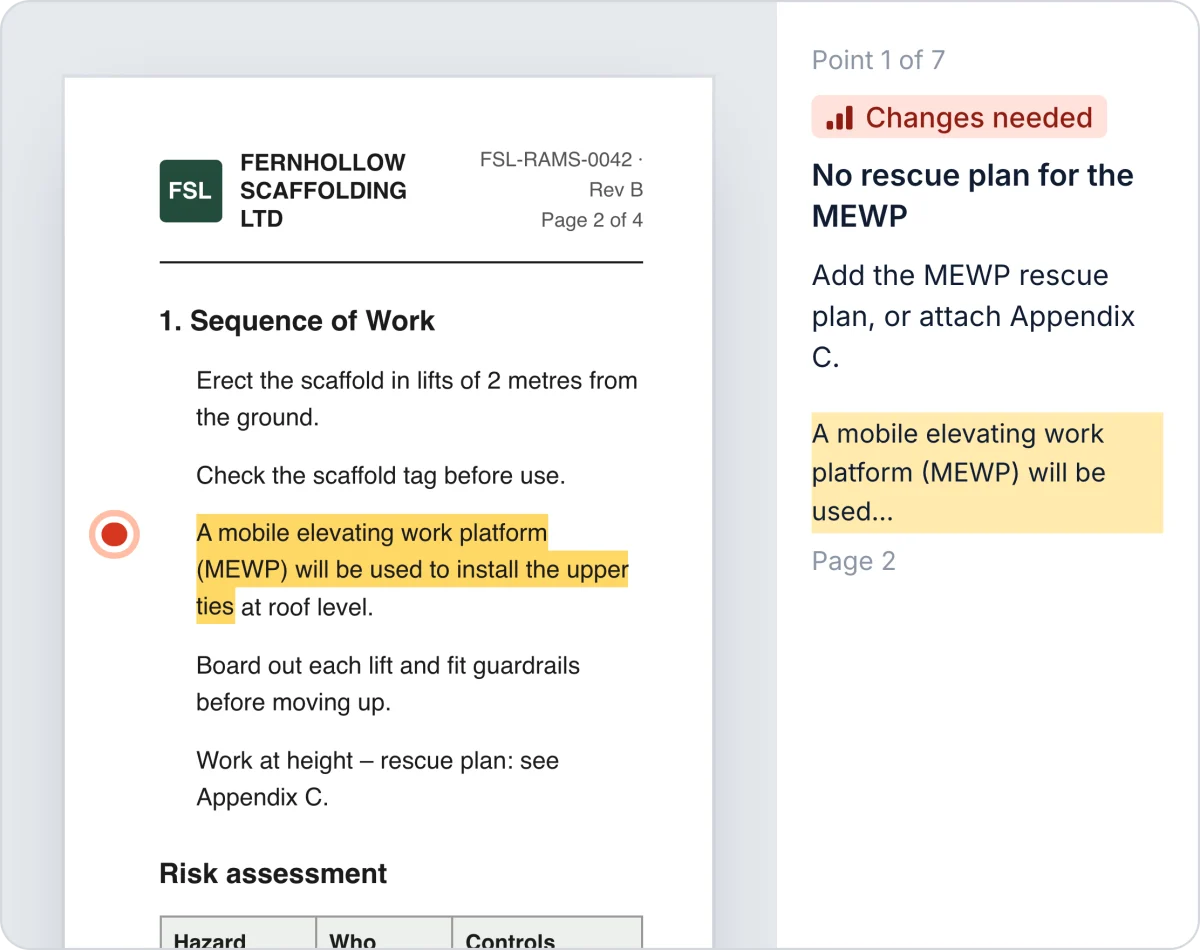
Ductwork access panel installation RAMS template
A blank ductwork access panel installation RAMS to fill in: job details, method statement, risk assessment and briefing record.
Risk assessment and method statement
Ductwork access panel installation RAMS
- Company
- left blank to fill in
- Site and work area
- left blank to fill in
- Planned dates
- left blank to fill in
- In charge on site
- left blank to fill in
- Team
- left blank to fill in
Method statement
- 1
- 2
- 3
- 4
- 5
- 6
Risk assessment
| Hazard | Who might be harmed and how | Controls in place | Further action |
|---|---|---|---|
Ductwork access panel installation RAMS example
The same RAMS, filled in for one job.
Risk assessment and method statement
Ductwork access panel installation, The Millers Arms, 22 Bridge Street, Stockport: kitchen
Risk assessment
People entering the work area or tripping over materials
Workers, occupants and visitors
Mark or barrier the active work area. Store tools and materials away from access routes.
A panel falls, binds or leaves the service opening unsafe
Installer and people below
Keep the opening supported and protected. Stop if its size or construction differs from the detail.
Breathing asbestos fibres from old boards, sheets, sealants or insulation
The team and anyone in the building
Do not cut, drill or break any material until it is confirmed asbestos free. Licensed work is not for this method; hand it to a licensed contractor.
Hitting a live cable or gas pipe causes shock, fire or gas escape
The person doing the work and everyone nearby
Check again wherever the work moves. If you hit something, stop, keep clear and report it.
Panels falling onto people below
People below
Bring waste down by hand or in bags. Never throw it. Keep the exclusion zone up until the last item is down.
Falling from the access equipment; tools or materials falling from the platform
The person on the platform, if it is set up on an unsuitable surface and shifts under them. Anyone passing or working underneath.
Place access equipment on a firm, level surface. Keep tools and materials secure while working above ground.
Back and shoulder injury from carrying heavy or long items
Everyone handling materials
Use a trolley or sack truck on the flat where the load suits one. Where the work is up a level, hand items up or hoist them. Never carry them up a ladder.
The frame pulls loose or the door cannot close correctly
Installer and building users
Use only the fixings named for the panel and opening. Keep hands clear while the frame is supported.
The panel cannot provide safe access or leaves an opening unsecured
Installer and service workers
Keep the panel supported during adjustment. Do not hand it over with a failed lock or hinge.
A defect or wrong panel is hidden until service access is needed
Service workers and building users
Keep the opening protected until the panel is secure. Report defects instead of concealing them.
Debris, tools or unfinished work left in the area
Workers, occupants and visitors
Remove waste by the agreed route. Record and protect any unfinished work.
Ductwork access panel installation, The Millers Arms, 22 Bridge Street, Stockport: kitchen
- Company
- Hollins & Reed Mechanical Ltd
- Site and work area
- The Millers Arms, 22 Bridge Street, Stockport: kitchen
- Planned dates
- 12 to 14 October 2026
- In charge on site
- Dan Hollins
- Team
- Two fitters: Dan Hollins leads and cuts and fits the opening; Priya Shah works with him.
Method statement
- 1Set up the work areaConfirm the work area and scope before starting. Keep other people outside the active work area. Keep entrances and escape routes clear.
- 2Check the formed openingCompare the opening with this job's panel instructions. Do not fix into an unsupported or unknown opening.
- 3Check for asbestos before you disturb anythingCheck the asbestos survey covers exactly what you will disturb, to the full depth. Register only, or nothing: get a refurbishment survey or a sample first. Read what it says about boards, sealants or insulation around the access panel. No survey, or a material you do not recognise: stop and get it checked.
- 4Find and isolate hidden servicesFind cables and pipes before you disturb anything: drawings, then a detector. Mark what you find. Not sure what is there? Turn the supply off, or do not start. Have cables and gas isolated by the right person and prove them dead before you start.
- 5Stop things falling on people belowKeep people out of the area below the work so nobody walks under the panels. Keep toe boards and guards in place on any platform, and lanyard tools where you can.
- 6Set up access equipmentUse access equipment suited to the task and work area. Check the equipment before use. Keep the area below the work controlled.
- 7Carry the access panels safelyPlan the route, clear it, and get help with anything long or heavy. Store materials close to the work so nobody carries further than they need to.
- 8Plumb and level the frameUse this job's fixings on each side and keep the frame supported while fixing. Stop if the panel, opening or fixing detail is not confirmed.
- 9Test the panel before handoverOpen and close the panel without forcing it. Correct rubbing, misalignment or a failed latch before handover.
- 10Leave the access point readyRemove tools and debris and leave the panel clean and usable. Record any defect or fire detail that still needs action.
- 11Clear and hand back the areaRemove tools, waste and unused materials. Check the area is clean and ready to use. Tell the customer or whoever runs the site when the work is complete.
What a ductwork access panel installation RAMS covers
Cutting in and fixing access panels on ductwork, and opening and resealing existing ones. Not covered: installing new ductwork.
- Fit a service panel
- Open and restore access
Suggested steps and hazards for ductwork access panel installation
Suggested for fit a service panel before any questions are answered.
Check the formed opening
- Compare the opening with this job's panel instructions.
- Do not fix into an unsupported or unknown opening.
Hazard
A panel falls, binds or leaves the service opening unsafe.
Who might be harmed and how
Installer and people below
Controls in place
- Keep the opening supported and protected.
- Stop if its size or construction differs from the detail.
The opening must match the panel before it can be fixed safely.
Premium double door access panel fitting instructions Plumb and level the frame
- Use this job's fixings on each side and keep the frame supported while fixing.
- Stop if the panel, opening or fixing detail is not confirmed.
Hazard
The frame pulls loose or the door cannot close correctly.
Who might be harmed and how
Installer and building users
Controls in place
- Use only the fixings named for the panel and opening.
- Keep hands clear while the frame is supported.
A plumb and level frame supports the panel and lets its doors close correctly.
Premium double door access panel fitting instructions Test the panel before handover
- Open and close the panel without forcing it.
- Correct rubbing, misalignment or a failed latch before handover.
Hazard
The panel cannot provide safe access or leaves an opening unsecured.
Who might be harmed and how
Installer and service workers
Controls in place
- Keep the panel supported during adjustment.
- Do not hand it over with a failed lock or hinge.
Testing the panel finds rubbing, alignment and latch defects before service access is needed.
Premium double door access panel fitting instructions
What the builder asks about ductwork access panel installation
Your answers decide which steps, hazards and controls it suggests.
The job
- What must the panel let you reach?
- What system is behind the panel?
Where
- Is the building older than the year 2000? Older buildings can have asbestos in them.
- What pipes or cables run around the formed opening and frame?
How it’s done
- What will you stand on to reach the work?
- What panel and opening information do you have?
- How will the system be made safe?
- How will the access panels get to the work?
What you’ve been told
- Does the surrounding construction need fire performance?
- How will the panel be restored?
What your ductwork access panel installation RAMS includes
Method statement
The work in order, step by step.
Risk assessment
Each hazard, who could be harmed, the controls in place and any further action.
The method statement and risk assessment in one A4 PDF. Your logo on Pro and Team.
What the law asks for
What a RAMS is
A risk assessment and method statement. The risk assessment records what could cause harm on the job, who could be harmed and how, and the controls that keep the risk down. The method statement sets out how the work will be done, step by step, in the order it happens.
A client or main contractor will usually ask for one before you start. RAMS is a site term, not a legal one: the law asks for the risk assessment and for the work to be planned, and a method statement is the usual way to show that plan for one job.
What the law asks for
- Employers, and self-employed people doing construction work, must make a suitable and sufficient assessment of the risks to their own people and to anyone else affected by the work (Management of Health and Safety at Work Regulations 1999, regulation 3).
- An employer with five or more employees must record the significant findings and any group of employees it finds especially at risk. The assessment must be reviewed if there is reason to think it is no longer valid, or the work has changed significantly.
- Every contractor must plan, manage and monitor its work so that, so far as is reasonably practicable, it is done without risks to health and safety, and must give its workers the information and instructions they need, including the hazards the risk assessment found (Construction (Design and Management) Regulations 2015, regulation 15).
HSE guidance: the steps to manage risk and what contractors must do under CDM. This is the law in Great Britain; Northern Ireland has its own equivalent regulations.
What the builder does
You choose the work and answer questions about how the job will be done, such as what you will stand on and what else is going on nearby. Your answers decide which steps, hazards and controls it suggests.
Many suggestions link to the HSE guidance they draw on. Your work is kept in this browser and, signed in, on your account with its photos; the PDF is made on your device. A briefing you send to phones goes through your account.
Separate documents
A COSHH assessment, lifting plan, permit to work, asbestos survey and the principal contractor’s construction phase plan are separate from the RAMS.
Reviewing a RAMS before work starts
RAMS review reads a RAMS PDF, yours before you send it or one a subcontractor sends you, and lists the points to raise, each marked on the page it comes from. Quick reviews are free.