
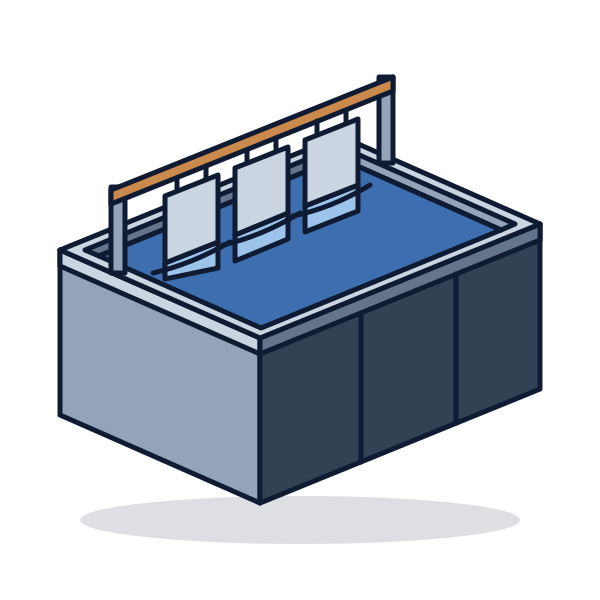
F019 RCRA waste code Sludge from treating wastewater at aluminum coating lines.
- Free, no account
- Based on 40 CFR 261.31 and EPA hazardous-waste rules
- Nothing is stored
Find a federal hazardous waste code
F019, Wastewater sludge from aluminum conversion coating.
F-listed waste
Wastewater sludge from aluminum conversion coating
F-list process waste.

Is F019 hazardous waste?
Yes. F019 is a nonacute F-listed hazardous waste when the named source process and waste stream match. The federal table gives it hazard code T for toxicity.
F019 is listed by source, so how and where the waste arose decides it, not a concentration test alone. A test can add a characteristic code but doesn't remove the listing once its conditions are met. On a required hazardous waste manifest, put F019 in Item 13. Look up the VSQG exemptions and empty-container rules too.
What does F019 cover?
Wastewater treatment sludge from chemical conversion coating of aluminum. Zirconium phosphating alone in aluminum can washing is outside F019. The motor-vehicle zinc-phosphating exception needs complete automobile or light-truck or chassis manufacturing, no outdoor land placement before the sludge ships to a landfill, a qualifying landfill and the required records.
- Hazard code
- T for toxicity
- Rule
- 40 CFR 261.31
Is aluminum conversion-coating sludge F019, F012 or F011?
| Code | When it fits |
|---|---|
| F019 | Aluminum conversion-coating generates wastewater sludge outside the zirconium-only can-washing and fully qualifying complete-vehicle or chassis zinc-phosphating exceptions. |
| F012 | Quenching waste water treatment sludges from metal heat treating operations from a process that uses cyanide. |
| F011 | Spent cyanide solutions from salt bath pot cleaning from metal heat treating operations. |
The operation and waste form pick the listing, not the chemical content alone. The rows show nearby listed streams, not every code that could apply. Add any characteristic or other listing that also fits, since one waste can carry more than 1 federal code.
What does the F019 motor-vehicle exception require?
The exception covers making automobiles and light trucks or utility vehicles, including light vans, pickup trucks, minivans and sport utility vehicles. The facility must build complete vehicles (body and chassis, or unibody) or chassis only. Making parts alone doesn't qualify.
The sludge must not sit outside on land before it ships for landfill disposal. The landfill must be a state-authorized Subtitle D municipal or industrial unit with a single clay liner, or a unit that is subject to or meets 258.40, 264.301 or 265.301.
Keep records on site for at least 3 years. They show the volumes generated and disposed of off site, the generation and shipment dates, the recipient's name and address, and confirmation of receipt. An enforcement action or regulator request extends the retention period. The records must show the exception's conditions were met.
Which wastes take F019?
| Waste | When it’s F019 |
|---|---|
| Electroplating wastewater treatment sludge | Aluminum conversion-coating sludge |
Sources
- 40 CFR 261.31 — Hazardous wastes from non-specific sources
- 40 CFR 261.3 — Definition of hazardous waste
- 40 CFR 261.4 — Exclusions
- 40 CFR 260.10 — Definitions
- 40 CFR 262.14 — Conditions for exemption for a very small quantity generator
- 40 CFR 262.20 — General requirements
- Hazardous Waste Manifest Instructions
- 40 CFR 261.7 — Residues of hazardous waste in empty containers