
Roofing method statement template
Choose a method statement design
Method statement for your trade
Your blank is set up for roofing. Back to the blank
RAMS for every tradeThree method statement layouts: Standard, Short task and With hold points
A hold point is a step where work stops until someone has checked it and signed it off, such as no tiling or boxing in over pipe that has not passed its pressure test. Use the layout with hold points when the job has them.
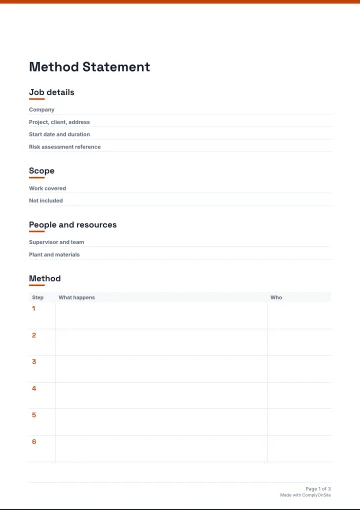
Standard
Job details, ten numbered steps with who does each, the sequence of works, emergency and the briefing record.
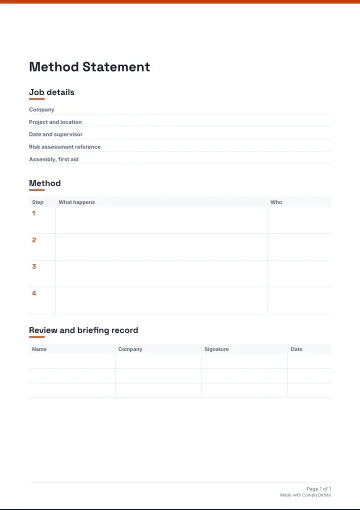
Short task
Job details, four steps and three signatures on one page.
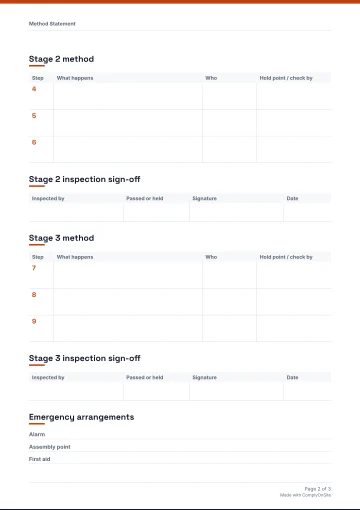
With hold points
The method in three stages, each step with who checks it and a signed inspection before the next stage.
All three carry a line for the risk assessment reference, so the method and the risk assessment it goes with are read together. None has a risk table.
What a method statement is, and what it is not
A method statement says how the job will be done, step by step, in order, with who does what.
A risk assessment says what could hurt someone and the controls.
A client or main contractor usually asks for the two together, as a RAMS.
Need both? Use the RAMS templateWhat the method statement template includes
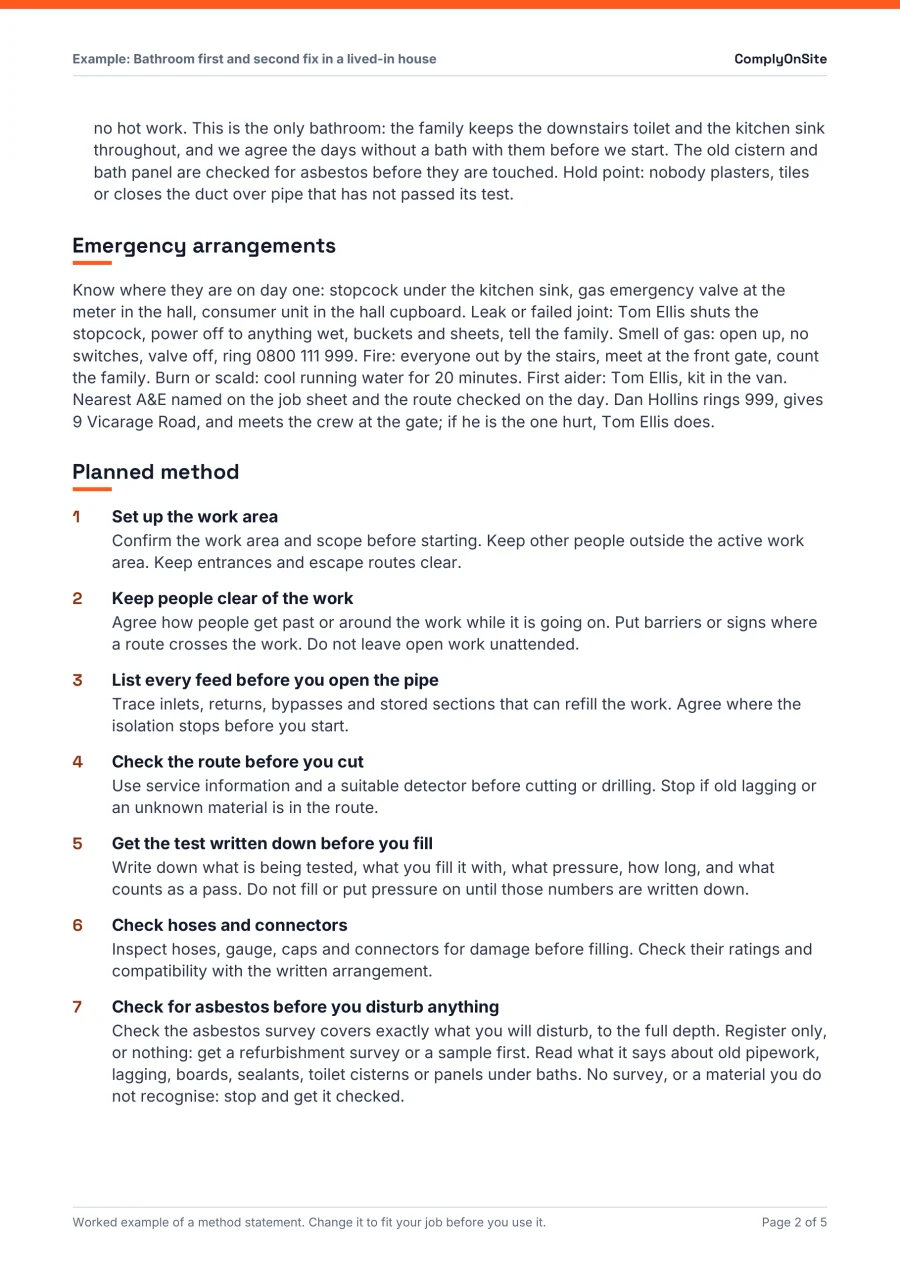
Hold points and checks
Where work stops until someone has checked it.
Emergency arrangements
First aid, assembly point and how help gets in.
Method, numbered
Each step in order, with who does it.
Job details and references
Project, client, dates and the risk assessment it goes with. On page 1.
Scope and sequence
What the work covers and the order it runs in. On page 1.
People, plant and materials
Who is on the job and what they use. On page 1.
Briefing record
Who was briefed, with a signature each. In the template, not in this example.
Number the steps in the order they happen on the day, and name who does each. Put a hold point wherever a later step would hide or depend on earlier work, such as a test, an inspection or a permit. Brief it before work starts, and review it with the risk assessment when the job changes.
No fixed form in law. The principal contractor or client usually sets what they want to see.
Bathroom plumbing, a worked exampleMethod statement questions
Is it free?
Yes. There is no account and no email to give. The Word and PDF files are made in your browser, and your last design is kept in this browser for next time.
What goes in a method statement?
The job and the risk assessment it goes with, what the work covers, who does it and with what, then each step in order with who does it, the checks, the emergency arrangements and who was briefed. Write it for the site in front of you, so someone new to the job could follow it.
Who writes it and who signs it?
Usually the contractor doing the work writes it, as part of planning that work and telling its workers how it will be done (CDM 2015, regulation 15). No law names who signs. Each person briefed signs the briefing record.
Is a method statement a legal requirement?
No law names one for most work: HSE calls it a practical way to plan, manage and monitor the job, not a legal requirement. Demolition, dismantling and structural alteration must be planned in writing before work starts, usually as a method statement. Every contractor must plan, manage and monitor its work (regulation 15), and a principal contractor the construction phase (regulation 13). A method statement is the usual way to show that plan for one job. The risk assessment is the legal duty (MHSWR, regulation 3).
Can I use it with my own risk assessment?
Yes. The job details have a line for the risk assessment reference, so the two stay together. Keep them side by side on site and brief them at the same time, so nobody follows the steps without the controls. If you have neither, the RAMS template puts both in one document.