
Method statement examples
All 19 examplesPainting and decorating method statement example
Water-based paint from a podium, walls filled and sanded first, one bay screened off at a time while staff work on.
Sources
Worked example of a method statement. Change it to fit your job before you use it.
Repainting occupied offices
Job details
- CompanyHollins & Reed Decorating Ltd
- Site and work areaSecond floor offices, 14 Mill Street, Stockport
- Planned dates12 to 14 October 2026
- CustomerThornley Vale Estates Ltd
- In charge on siteDan Hollins
- TeamTwo decorators: Dan Hollins leads and agrees each room with the office manager; Priya Shah works with him.
- WorkRepainting occupied offices
- Risk assessmentRepainting occupied offices: worked example RAMS, a separate document
Work and boundaries
- Prepare surfaces, paint by brush or roller. Areas: Meeting rooms 1 and 2; Open-plan office; Corridor
Working arrangement
- Access: a podium.
- Working height: rooms about 2.7 m.
- Ground or floor: level, carpeted.
- Sanding dust: On-tool extraction.
- Paint: water-based matt emulsion, data sheet with the office manager.
- Other people will use parts of the area at times.
- Offices stay in use; each bay is screened off and released to us by the office manager, one at a time, and desks are moved only with staff agreement. Fire doors are never wedged; corridors and stairs stay clear. Only the day’s paint comes to the work, lids on; tins and wash water go by the agreed waste route. The older paint was tested with a lead test kit: no lead found. The asbestos survey covers the textured ceilings: none found. A detector head goes off only with the building manager’s agreement: the second decorator checks that area while it is off, and it is back on before we leave.
Emergency arrangements
- Fire bell: stop, close the tins and leave by Stair B. Do not use the lifts. Muster at Car Park C and report to the floor marshal. Fall from the podium: stop, do not move someone with a back or neck injury unless they are in danger. Spill or anyone unwell from the paint: open up, move staff away, stop using the product and bring the data sheet; tell the building manager at once. First aid: Reception, ext 200. Priya Shah rings 999; Reception meets the crew at the Mill Street door.
Planned method
- 1. Set up the work areaConfirm the work area and scope before starting. Keep other people outside the active work area. Keep entrances and escape routes clear.
- 2. Keep people clear of the workAgree how people get past or around the work while it is going on. Put barriers or signs where a route crosses the work. Do not leave open work unattended.
- 3. Check the paint informationRead each label and safety data sheet before opening or mixing paint. Keep the product names with the RAMS.
- 4. Check preparation productsRead labels and safety data sheets for cleaners, fillers and strippers. Set skin, eye and ventilation controls before use.
- 5. Check the surface as you goCompare the surface with the agreed description before scraping, filling or stripping. Stop if the material, coating or damage is different.
- 6. Check for asbestos before you disturb anythingCheck the asbestos survey covers exactly what you will disturb, to the full depth. Register only, or nothing: get a refurbishment survey or a sample first. Read what it says about old paint, textured coatings, boards and walls. No survey, or a material you do not recognise: stop and get it checked.
- 7. Set up access equipmentUse access equipment suited to the task and work area. Check the equipment before use. Keep the area below the work controlled.
- 8. Set fresh air before paintingOpen doors and windows where the site allows it. Use the ventilation named by the product assessment.
- 9. Keep paint tins closedClose tins and containers when they are not being used. Clean spills with the agreed waste method.
- 10. Control sanding dustUse the sanding dust method named in this document, and stop if it fails. Wear an APF 20 mask (FFP3 or P3) for dusty sanding: fit tested and clean-shaven.
- 11. Apply the specified paintUse the specified brush or roller and follow the product order and drying instructions.
- 12. Keep people away from wet paintMark or barrier wet areas and protect floors and fittings. Only hand the area back when the product allows it.
- 13. Wash before leaving the jobWash hands after painting and before eating, drinking or smoking. Change contaminated clothing where the assessment requires it.
- 14. Clean up without raising dustUse a suitable vacuum for settled dust and collect wet waste safely. Do not dry sweep or blow dust into the room.
- 15. Clear and hand back the areaRemove tools, waste and unused materials. Check the area is clean and ready to use. Tell the customer or whoever runs the site when the work is complete.
Choose a job
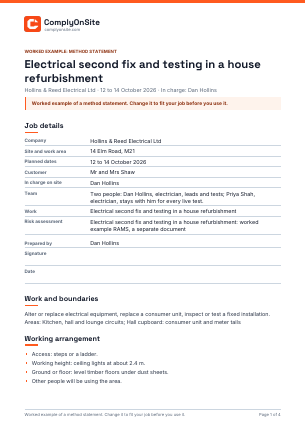
- Electrical second fix and testing in a house refurbishment Lived-in 1970s house, accessories and consumer unit fitted, one circuit dead at a time, tested dead then live before handover.
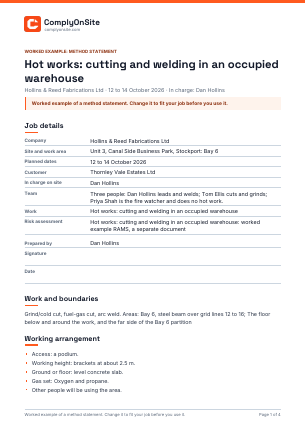
- Hot works: cutting and welding in an occupied warehouse Steel brackets cut out and replaced on a live bay, with a permit for each shift and a separate fire watcher.
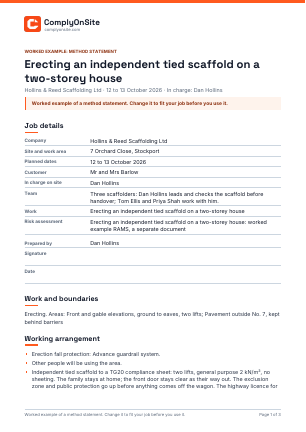
- Erecting an independent tied scaffold on a two-storey house Independent tube and fitting scaffold to a TG20 compliance sheet, family at home, rescue kit on the wagon.
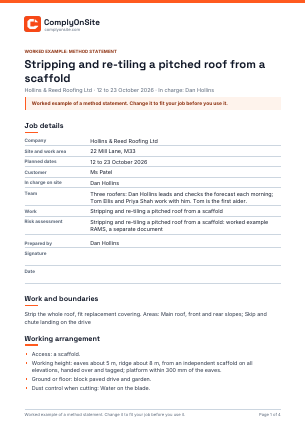
- Stripping and re-tiling a pitched roof from a scaffold Lived-in house, tiles, battens and underlay off, one section made weathertight each day.
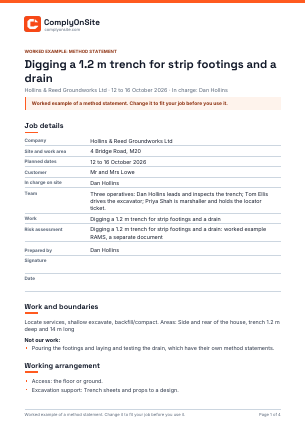
- Digging a 1.2 m trench for strip footings and a drain Beside a lived-in house, services located first, excavator then hand tools, trench sheets and props before anyone goes in.
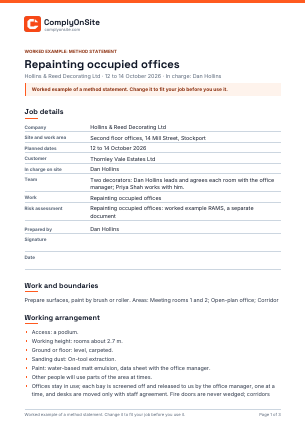
- Repainting occupied offices Water-based paint from a podium, walls filled and sanded first, one bay screened off at a time while staff work on.
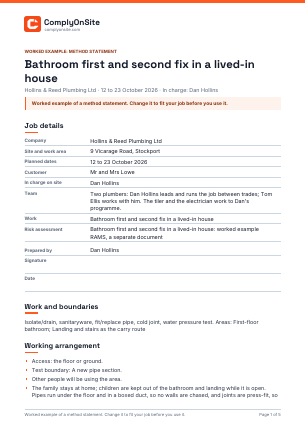
- Bathroom first and second fix in a lived-in house Only bathroom replaced, press-fit pipework under the floor and in a duct, tested before anyone closes it up, suite fitted after tiling.
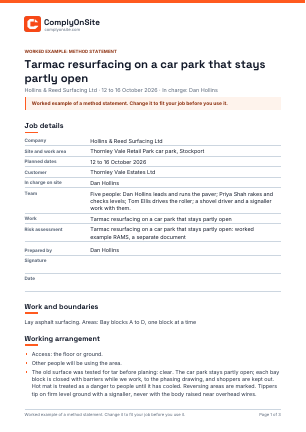
- Tarmac resurfacing on a car park that stays partly open Old surface tested and planed off, private retail car park, laid bay block by bay block with shoppers around.
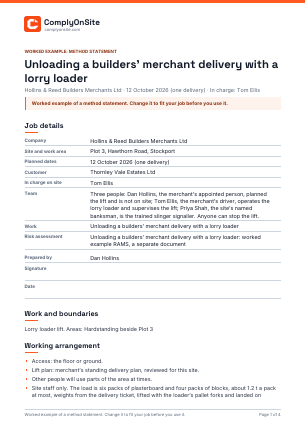
- Unloading a builders’ merchant delivery with a lorry loader Packs of blocks and plasterboard landed on a small building site, on a standing lift plan reviewed for this site.
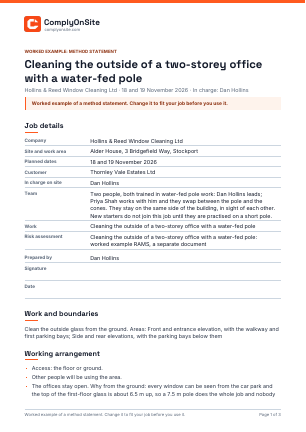
- Cleaning the outside of a two-storey office with a water-fed pole All from the ground, in an open office set back behind its own car park, on cold November mornings.
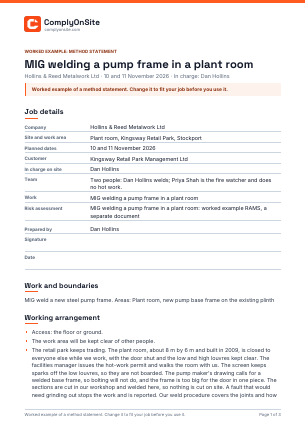
- MIG welding a pump frame in a plant room MIG welding bare mild steel at floor level in a closed plant room, with on-torch extraction, while the retail park keeps trading.
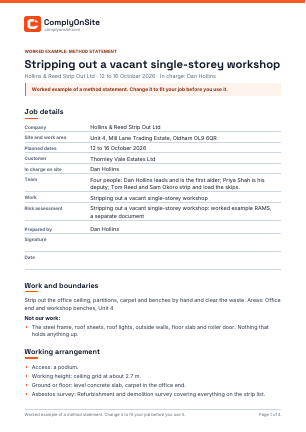
- Stripping out a vacant single-storey workshop Office ceiling, partitions, carpet and benches out by hand, building empty, every service including the fire alarm disconnected on a certificate, lit by roof lights and a 110 V string.
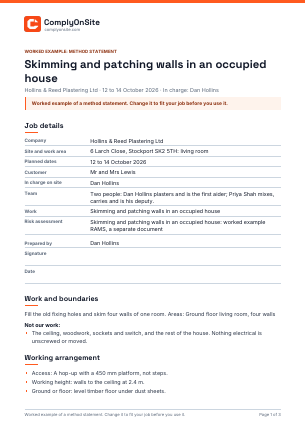
- Skimming and patching walls in an occupied house Ground floor living room of a 2006 house, family at home, plaster mixed in the room with the door shut, from a hop-up.
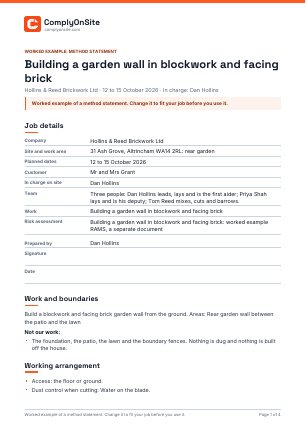
- Building a garden wall in blockwork and facing brick A 5 m long, 1 m high wall, one brick thick, on a foundation already in, laid from the ground.
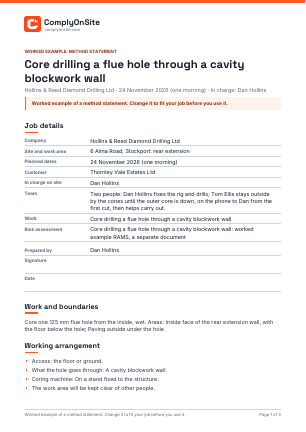
- Core drilling a flue hole through a cavity blockwork wall One 125 mm wet core, rig fixed to the inner leaf, through an external wall of a single-storey extension, with the core caught outside.
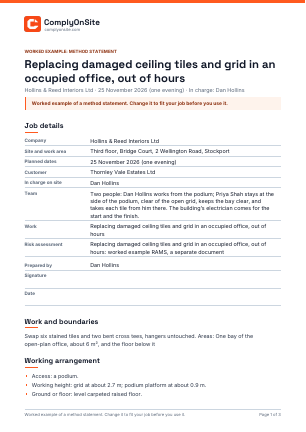
- Replacing damaged ceiling tiles and grid in an occupied office, out of hours Like-for-like tiles and tees on the existing hangers, from a podium, with the offices empty and the fire alarm left live.
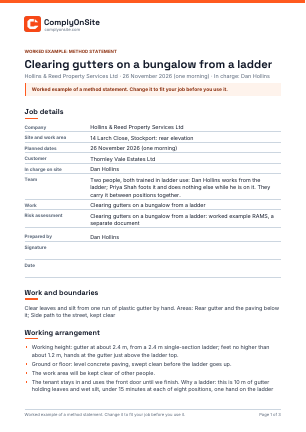
- Clearing gutters on a bungalow from a ladder Eight ladder positions of under 15 minutes each, one hand on the ladder, with a stand-off keeping it clear of the gutter.
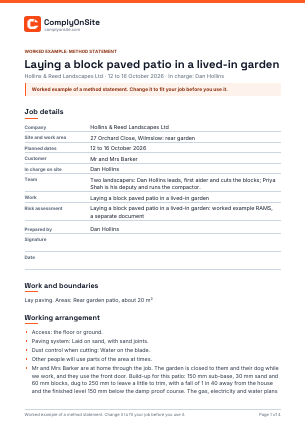
- Laying a block paved patio in a lived-in garden Dug out by hand to 250 mm, sub-base compacted, blocks laid on sand and cut wet, family at home.
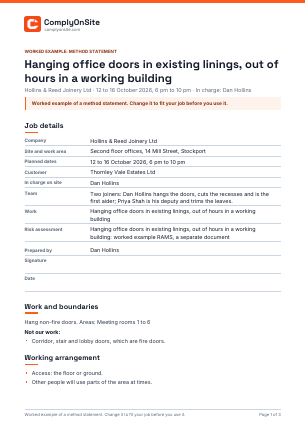
- Hanging office doors in existing linings, out of hours in a working building Six heavy non-fire meeting room doors, trimmed and routed on trestles after the staff have gone.
What a finished method statement says
- The job and its boundariesWhat is being done, where, and what is not your work.
- How the work area is set upAccess, shared spaces and who else is around.
- The steps, in the order they happenOne action to a step, from arrival to sign-off.
- Who does each stepThe people in charge and the skills each step needs.
- What happens if something goes wrongWho to call, where to go and how help gets in.
Method statement or risk assessment: which one is this?
This is the method statement: how the job is done, step by step. The risk assessment says what could go wrong and what controls it.
See both together in the Painting and decorating RAMS example.