
COSHH assessment examples
All 15 examplesCement and mortar COSHH assessment example
Bricklaying and small pours. The risk is skin: dermatitis and burns.
Sources
Worked example. Typical product. Your supplier’s safety data sheet governs.
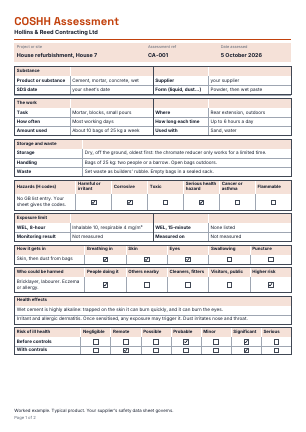
Sheet 1: COSHH Assessment
Hollins & Reed Contracting Ltd
- Project or siteHouse refurbishment, House 7
- Assessment refCA-001
- Date assessed5 October 2026
Substance
- Product or substanceCement, mortar, concrete, wet
- Supplieryour supplier
- SDS dateyour sheet’s date
- Form (liquid, dust…)Powder, then wet paste
The work
- TaskMortar, blocks, small pours
- WhereRear extension, outdoors
- How oftenMost working days
- How long each timeUp to 6 hours a day
- Amount usedAbout 10 bags of 25 kg a week
- Used withSand, water
Storage and waste
- StorageDry, off the ground, oldest first: the chromate reducer only works for a limited time.
- HandlingBags of 25 kg: two people or a barrow. Open bags outdoors.
- WasteSet waste as builders’ rubble. Empty bags in a sealed sack.
Hazards (H codes)
- No GB list entry. Your sheet gives the codes.Harmful or irritant: yes. Corrosive: yes. Toxic: no. Serious health hazard: yes. Cancer or asthma: no. Flammable: no
Exposure limit
- WEL, 8-hourInhalable 10, respirable 4 mg/m³
- WEL, 15-minuteNone listed
- Monitoring resultNot measured
- Measured onNot measured
How it gets in
- Skin, then dust from bagsBreathing in: yes. Skin: yes. Eyes: yes. Swallowing: no. Puncture: no
Who could be harmed
- Bricklayer, labourer. Eczema or allergy.People doing it: yes. Others nearby: no. Cleaners, fitters: no. Visitors, public: no. Higher risk: yes
Health effects
- Wet cement is highly alkaline: trapped on the skin it can burn quickly, and it can burn the eyes.
- Irritant and allergic dermatitis. Once sensitised, any exposure may trigger it. Dust irritates nose and throat.
Risk of ill health
- Before controlsNegligible: no. Remote: no. Possible: no. Probable: yes. Minor: no. Significant: yes. Serious: no
- With controlsNegligible: no. Remote: yes. Possible: no. Probable: no. Minor: no. Significant: yes. Serious: no
Sheet 2: COSHH Assessment
Hollins & Reed Contracting Ltd
- Project or siteHouse refurbishment, House 7
- Assessment refCA-001
- Date assessed5 October 2026
Controls
- Avoid or swap itIn place: Ready-mixed for pours. Site mixer only for mortar. Still needed: Ask for pre-mixed mortar next.
- Change the methodIn place: Long-handled tools. Knee boards when screeding.
- Extract at sourceIn place: Not used: open air. Open bags outdoors, slowly.
- Fewer, for less timeIn place: Two people only on mixing.
- Washing, welfareIn place: Warm water, soap, towels. Wash at breaks and after work. Still needed: Skin cream at the cabin.
PPE: type or standard
- EN 374 nitrile or PVC gloves. Trousers over boots.Gloves: yes. Eye protection: yes. RPE: no. Overalls: yes. Boots: yes
If it goes wrong
- Spill or leakScrape up, keep out of drains, let it set, bag it.
- FireDoes not burn.
- Breathed in or swallowedMove to fresh air. Rinse mouth with water.
- On skin or in eyesSkin: wash off, flood for 20 minutes, treat as a burn. Eyes: flush at least 10 minutes, then hospital.
Also needed
- Exposure monitoringYes: no. No: yes. Detail: Dust is brief and outdoors.
- Health surveillanceYes: yes. No: no. Detail: Skin checks by a responsible person. Next due: Weekly
- LEV examinationYes: no. No: yes. Detail: None used.
- RPE face-fit testYes: no. No: yes. Detail: None used.
- Training, supervisionYes: yes. No: no. Detail: Dermatitis signs, washing, gloves. Next due: Before start
Further action
- Train a responsible person for skin checksWho: DH. By when: Before start
- Baseline skin check on both workersWho: DH. By when: Before start
Date
- 5 October 2026By: DH. Review: reason and changes: First issue. Next review: 5 October 2027
Sign-off
- Assessed byDan Hollins
- Date5 October 2026
- Shared with workers on6 October 2026
Choose a substance or task
- Wet cement, mortar and concrete on a house refurbishment Bricklaying and small pours. The risk is skin: dermatitis and burns.
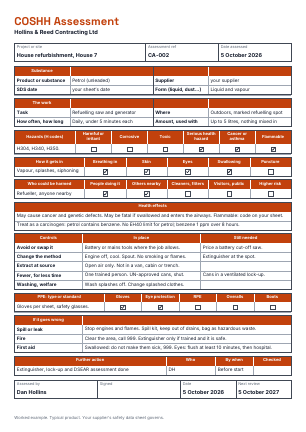
- Petrol for a cut-off saw and generator Refuelling small plant on site. Fire first, then what is in the vapour.
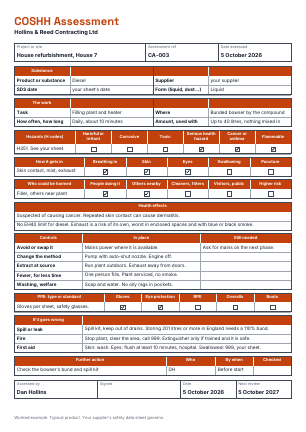
- Diesel for a dumper, generator and space heater Not the same as petrol: a different hazard entry, skin first, and oil storage rules.
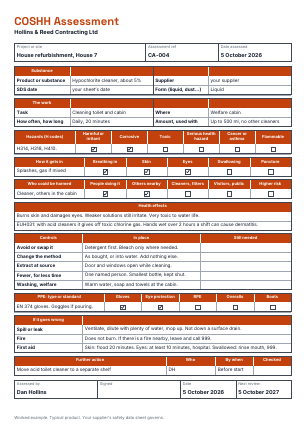
- Sodium hypochlorite cleaner in the welfare cabin Cleaning the toilet and cabin. Burns to skin and eyes, and gas if mixed.
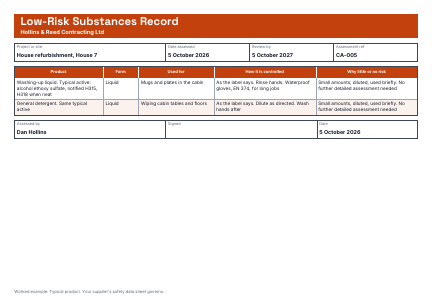
- Washing-up liquid and general detergents The right answer is a low-risk record, not a two-page assessment.
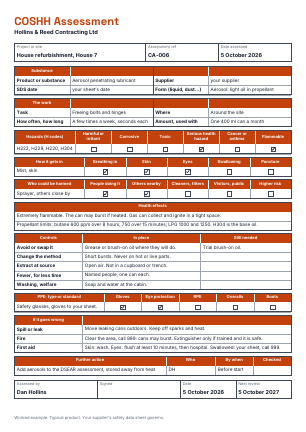
- Aerosol penetrating lubricant A small can with an extremely flammable propellant, used in tight spaces.
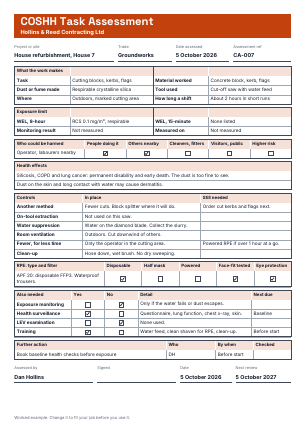
- Cutting blocks, kerbs and flags with a cut-off saw Made by the work, so no safety data sheet comes with it. Lung disease is the risk.
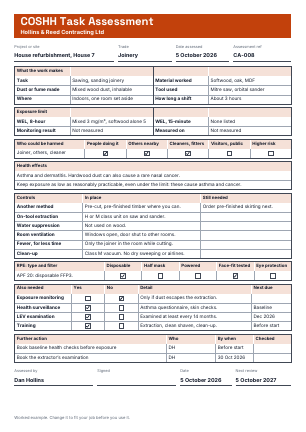
- Sanding and sawing softwood, hardwood and MDF Second-fix joinery. An asthma risk, and hardwood is also a cancer risk.
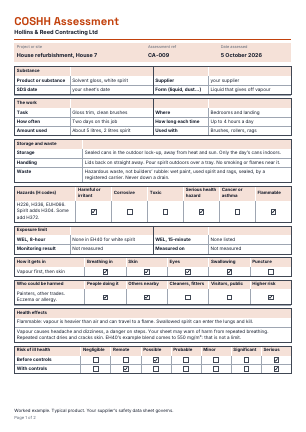
- Solvent gloss paint and white spirit on a house refurbishment Brushing doors and trim, then cleaning brushes. A flammable liquid with a vapour and skin risk.
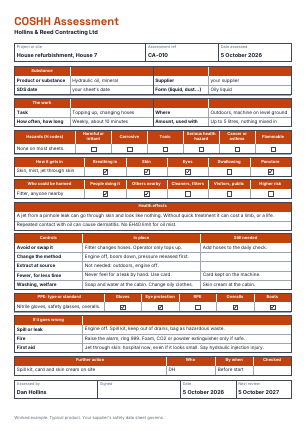
- Hydraulic oil on a mini excavator and breaker Topping up and changing a split hose. Low hazard on the sheet, but a pinhole jet can go through skin.
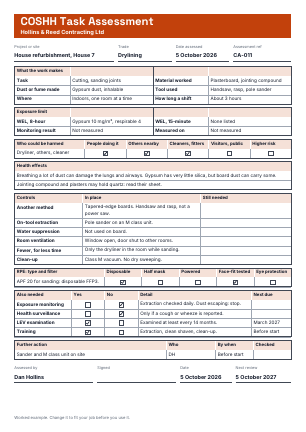
- Cutting and sanding plasterboard on a drylining job Made by the work, so no safety data sheet comes with the dust. Low in silica, but sanding makes a lot of it.
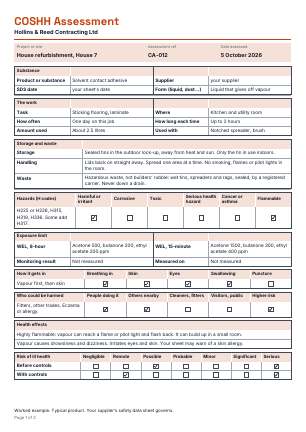
- Solvent contact adhesive for sheet flooring and worktop laminate Spreading adhesive in a small room. Fire first, then the solvent vapour.
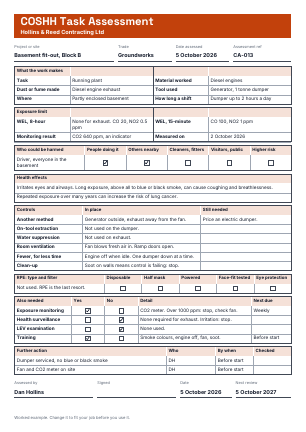
- Generator and dumper exhaust at a partly enclosed basement Made by the work, so no safety data sheet comes with it. Worst in an enclosed space, or with blue or black smoke.
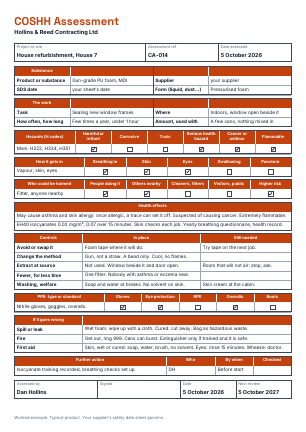
- Gun-grade PU foam around window frames A few cans a few times a year. A bead from a gun, not a spray. The isocyanate can cause asthma, and the can is extremely flammable.
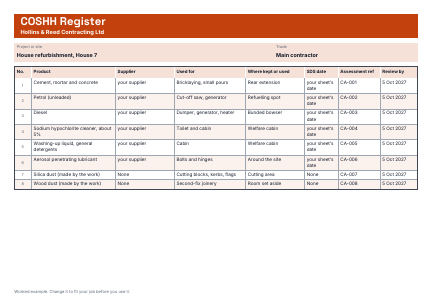
- A COSHH register for a house refurbishment Every product and dust on the job, one line each, pointing to its assessment. It does not replace them.
What a filled COSHH assessment shows
Five things, in this order.
The substance and its H codes
From the supplier’s sheet, with its date. The sheet is your source; the form records what you did with it.
The work: how much, how often, how long
What is done, where, how much, how often and how long. The same product can be a different risk on a different job.
Who and how it gets in
The person doing it, anyone nearby, anyone at higher risk, and the routes in.
Controls in regulation 7 order, then PPE
Avoid it first, then change the method, extract, limit, and only then gloves and masks.
What else is needed and when it is reviewed
Monitoring, health checks, extraction tests and training, each with a date, then a review date.
COSHH example questions
Is this the assessment for my product?
No. Each one is a typical substance on a made-up job. Yours needs your supplier’s sheet, your amounts and your people.
Why no brand names?
Formulas differ and change, so no example speaks for a company’s product. If you searched for Fairy or WD-40, the washing-up and aerosol examples are the closest. Read the sheet for the one you hold.
Where do the numbers come from?
Hazard codes from the GB mandatory classification list where it has an entry, and exposure limits from EH40. Controls follow HSE guidance where HSE has a sheet for the task, and general practice where it does not. Each example lists its sources.
Can I copy an example?
Use it to see the level of detail, then write your own from your sheet. A form copied unchanged is not an assessment of your work.
Which form for a low-risk product?
The low-risk record, as in the washing-up example. If a label warns of more than eye or skin irritation, or you use it neat for long, use a full assessment instead.
Does it cover asbestos or lead?
No. Both have their own regulations, and COSHH does not apply to them in the same way. Take specialist advice.
Where is the blank?
On the COSHH assessment template, with your logo and the sections you need.